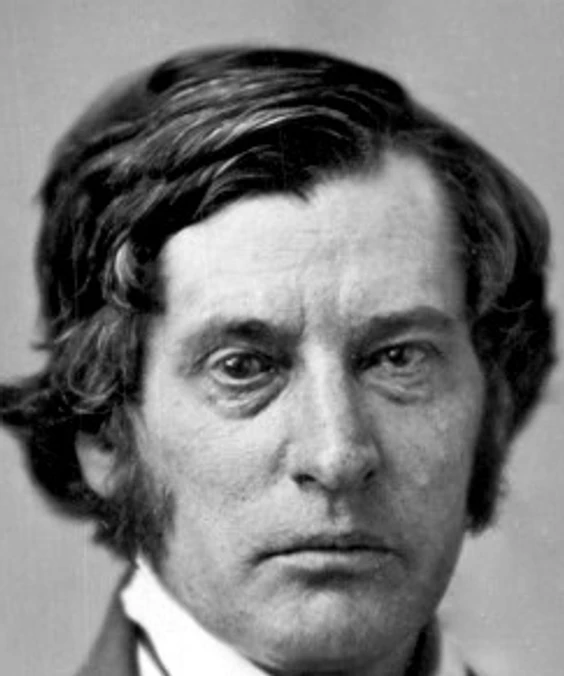
Congress, therefore, is responsible for its institutions, as a man is responsible for the condition of his house, and the customs of his family.
Horace Mann
The Public Record
Horace Mann was an American educational reformer, abolitionist and Whig politician known for his commitment to promoting public education; he is thus also known as The Father of American Education. In 1848, after public service as Secretary of the Massachusetts State Board of Education, Mann was elected to the United States House of Representatives (1848–1853). From September 1852 to his death in 1859, he served as President of Antioch College.
gutenberg.org
It is a great thing to us, because we are held responsible for it by the whole civilized world.
Surely its abandonment here would be a small thing to them, while its continuance is a great thing to us.
Now, in all sincerity, and in all kindness, I ask our southern brethren what there is to them so valuable and desirable in retaining slavery here, as to be a compensation for all the pain and evil which its existence inflicts upon the…
We believe it to be a denial of the rights of man; we believe it to be contrary to the law of God.
The whole system, with all its adjuncts, is irreconcilably repugnant to our ideas of justice.
Wherever we go, wherever we are, the odious, abhorred concomitants of this institution are forced upon our observation, and become a perpetual bitterness in the cup of life.
We know all this; we see its imbruting consequences; and we are compelled to see them, because the government will uphold slavery here.
But these lofty and enduring satisfactions,--this pleasure,--it is no extravagance to say, this bliss of knowledge, both for parent and child, is withheld, cruelly, remorselessly withheld, from the slave.
When the panting and thirsting soul first drinks the delicious waters of truth; when the moral and intellectual tastes and desires first seize the fragrant fruits that flourish in the garden of knowledge; then does the child catch a…
Superstition is the mathematical complement of religious truth; and just so much less as the life of a human being is reclaimed to good, just so much more is it delivered over to evil.
He who dethrones the idea of law, bids chaos welcome in its stead.
Ignorance breeds monsters to fill up all the vacuities of the soul that are unoccupied by the verities of knowledge.
He who shuts out truth, by the same act opens the door to all the error that supplies its place.
And still further, sir, I affirm, in words as true and literal as any that belong to geometry, that the man who withholds knowledge from a child not only works diabolical miracles for the destruction of good, but for the creation of evil…
Such a destroyer of knowledge dims the highest moral splendor of the universe.
I say, therefore, in strict, literal, philosophical truth, that whoever denies knowledge to children works devilish miracles.
To one whose mind is not made capacious of the future, and opened to receive it, all the great interests of futurity have less of reality than a dream.
To one who is permitted to know nothing of the charms and sublimities of science, all science is non-existent.
So, if a usurper of human rights takes away from a child the faculties of knowledge, or the means and opportunities to know, it is precisely the same to that child as though all the beauties and the wonders, all the magnificence and the…
If a man obliterates my power of vision, it is precisely the same to me as though he had blotted out the light of the sun, and flung a pall of darkness over all the beauties of the earth and the glories of the firmament.
If a man destroys my power of hearing, it is precisely the same to me as though, leaving my faculty of hearing untouched, he had annihilated all the melodies and harmonies of the universe.
The channels are so cut that all the sacred and healing waters of knowledge flow, not to him, but by him.
Is their futurity so uncertain or so worthless that they need no guide to a better country, or that they can be turned off with a guide as ignorant and blind as themselves?
Have they no need of consolation, of faith in the Unseen, to help them bear up under the burdens and anxieties of life?
Politicians like Horace Mann