If so, then the existence of slavery in this District is not “necessary” to the exercise of any of the expressly granted powers.
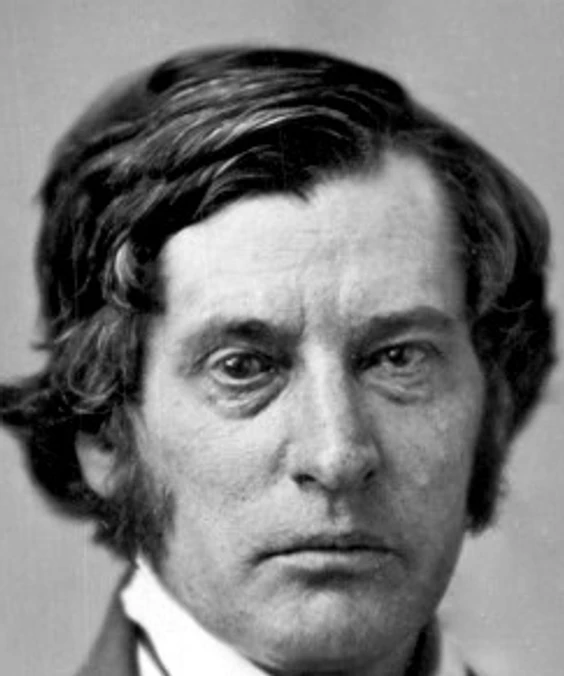
Horace Mann
The Public Record
Horace Mann was an American educational reformer, abolitionist and Whig politician known for his commitment to promoting public education; he is thus also known as The Father of American Education. In 1848, after public service as Secretary of the Massachusetts State Board of Education, Mann was elected to the United States House of Representatives (1848–1853). From September 1852 to his death in 1859, he served as President of Antioch College.
gutenberg.org
If slavery in the District of Columbia were to cease to-day, could not the government continue to exercise every function which it has heretofore exercised?
But to what one of all these powers is the power to establish slavery in the District of Columbia a necessary incident?
What power is granted to Congress, for the exercise of which the establishment of slavery in this District is a necessary means or a preliminary?
Nor can any power to establish slavery be deduced from the 18th clause of the 8th section of the 1st article of the constitution, which gives Congress power “to make all laws which shall be necessary and proper for carrying into execution”…
Will those who say that Congress cannot establish a banking institution by construction, nor aid internal improvements, nor enact a tariff,--will they say that Congress can make a man a slave, and all his posterity slaves, by construction?
Thousands of human beings are not to be robbed of all their dearest rights, and they and their children, forever, by strained constitutions, or apocryphal authority, doomed to bondage.
Where is there any express power given to Congress by the constitution to establish slavery?
My next proposition, therefore, is this: That as Congress can do nothing excepting what it is empowered to do by the constitution, and as the constitution does not empower it to establish slavery here, it cannot establish slavery here, nor…
I do not deny, then, that Congress used words of sufficient amplitude to cover slavery; but what I deny is, that it had any power to give legal force to those words.
It acted in plain contravention of some of the plainest and most obvious principles consecrated by the constitution.
Congress, in attempting to reënact the Maryland laws, to uphold slavery in this District, transcended the limits of its constitutional power.
So the law of Maryland might be valid under the constitution of Maryland, and, therefore, binding upon the citizens of Maryland; while the law of Congress, though framed in precisely the same words, would be repugnant to the constitution…
The law of Congress might be unconstitutional and void, while that of the British Parliament, framed in precisely the same language, might be constitutional and binding.
We have a written constitution; Great Britain has no written constitution.
Congress might pass a law in precisely the same words as those used by the Parliament of Great Britain, and yet the law of Congress be invalid and inoperative, while the act of Parliament would be valid and binding.
It makes all the difference in the world, whether words are used by one possessed of power, or by one devoid of power.
There are two governments that have the power to legislate for him; but there is only one power,--the Congress of the United States,--that can legislate for a citizen of the District of Columbia.
It means that no other government, no other body of men whatever, shall have concurrent power of legislation over the District; nor, indeed, any subordinate power, except what may be derived from Congress.
It cannot mean absolute and uncontrolled; for, if it did, it would make Congress as sovereign as the Russian autocrat.
My second position is this: That a man’s legal condition may be changed by a change in the government over him, while he remains in the same place, just as effectually as it can be changed by his removal to another place, and putting…
This is the solid and indestructible ground of the maxim, that slavery can exist only by positive law; that it is a local institution; that the right of freedom must first be abolished before slavery can exist.
Some act abolishing this freedom, then, must be proved; it must be proved affirmatively, or else the fact of freedom remains.
Like the right to life, it pertains, by the law of nature and of God, to every human being.
A slave passing out of a jurisdiction where slavery is legalized, into a jurisdiction where it is not, becomes free.
Politicians like Horace Mann