To prohibit Congress from doing one of these things, and to permit it to do the other, is straining at a gnat and swallowing a camel,--a whole caravan of camels!
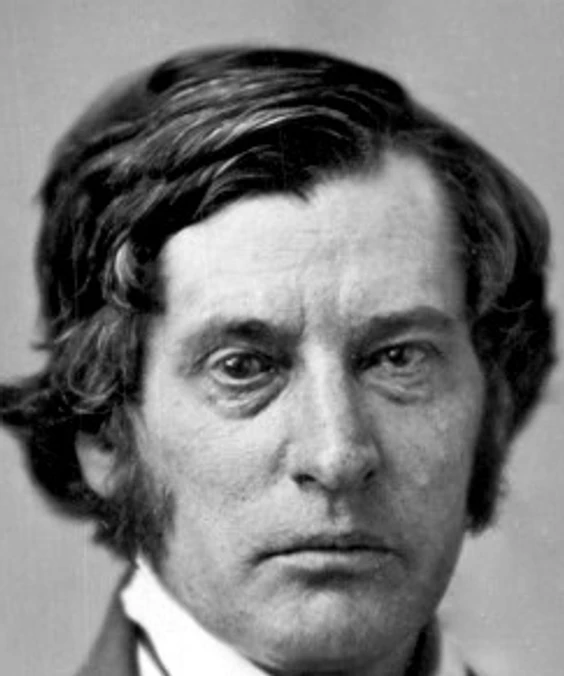
Horace Mann
The Public Record
Horace Mann was an American educational reformer, abolitionist and Whig politician known for his commitment to promoting public education; he is thus also known as The Father of American Education. In 1848, after public service as Secretary of the Massachusetts State Board of Education, Mann was elected to the United States House of Representatives (1848–1853). From September 1852 to his death in 1859, he served as President of Antioch College.
gutenberg.org
It can give to one class of men the power to own and to control, to punish and to despoil another class; to sell father, mother, wife, and children, into bondage.
Yet if Congress can create or legalize slavery, it can establish the worst order of nobility that ever existed.
Now, can any reasonable man for a moment suppose that the constitution meant to debar Congress from passing acts of attainder against individuals, but to permit it to pass wholesale, sweeping laws, working disfranchisement of an entire…
But here, Congress, in defiance of the constitution, has undertaken to establish a degraded caste in society, and to perpetuate it through all generations.
And this corruption of blood, which the law of slavery works, does not stop with the first, nor with the second generation,--not with the tenth nor the ten thousandth; but by the theory of the law, goes on forever.
A white man may give his testimony against him, but he cannot give his testimony against a white man.
A slave is an outlaw; that is, he cannot make a contract; he cannot prosecute and defend in court; property cannot be acquired by him, or devised to him, or transmitted through him.
It attainted, not individuals merely, but a whole race.
It makes a man incapable of acquiring, inheriting, or transmitting property; incapable of holding office, or acting as attorney for others; and it shuts the door of the courts against him.
If Congress cannot authorize searches and seizures of houses, papers, and effects, can it get round the constitution, by saying we will create a class of persons who shall have no power of owning any houses, papers, or effects, to be…
By its own selection of words it is debarred not merely from depriving a “freeman,” but from depriving a “person” of this right.
The word person was chosen, and therefore Congress has no constitutional power to deprive of life, liberty, or property, without due process of law, any being embraced in the definition of that word.
Hence, the act of Congress, purporting to continue the Maryland laws respecting slavery in this District, was, and is, and forever must be, until the constitution is altered, null and void.
A slave, therefore, in this District, is deprived of his liberty and property, in pursuance of the laws of Congress, without any legal process whatever, and therefore in flagrant contradiction of the fifth article of the Amendments to the…
There has been no “due” process of law to reduce him to this miserable condition; there has been no process of law at all.
Now, a slave is a person deprived of his liberty and property, without any process of law.
It embraces all, from the slave to the President of the United States.
It embraces Indians, if taxed; it embraces natives of Africa; it embraces apprentices and slaves, or those held to service or labor; and it embraces every citizen, from the humblest to the highest, from the most true to the most…
Now, it will be seen from all this, that the word “person” is used in the constitution in the most comprehensive sense.
Let us take our definition of the word “person” from the constitution itself.
Or who, under the constitution, is such a “person” as cannot be deprived of life, liberty, or property, by virtue of an act of Congress, without due process of law?
No PERSON shall be deprived of life, liberty, or property, without due process of law.” Now, what does this word “person” mean?
The fifth article of amendment declares that “no person shall be deprived of life, liberty, or property, without due process of law.
But there is another prohibition in the constitution every whit as full and explicit as any of these.
Politicians like Horace Mann