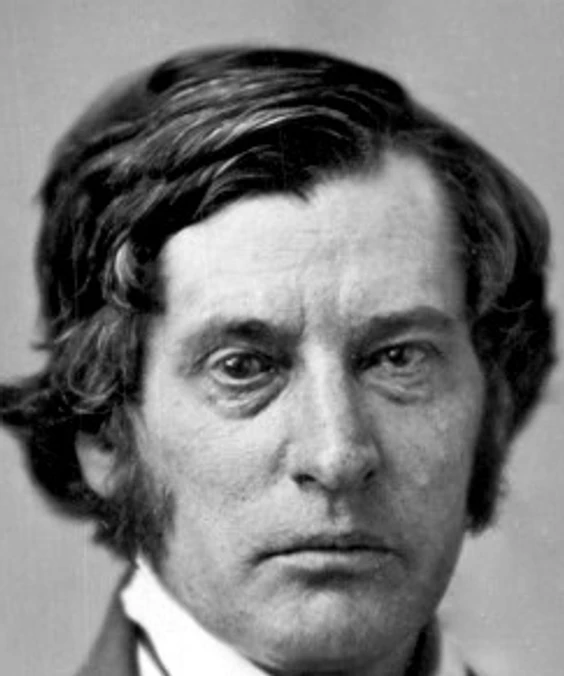
But if the word “Abolitionist” is to be used in a reproachful and contumelious sense, does it not more properly belong to those who would extend a system which in its very nature abolishes freedom, justice, equity, and a sense of human…
Horace Mann
The Public Record
Horace Mann was an American educational reformer, abolitionist and Whig politician known for his commitment to promoting public education; he is thus also known as The Father of American Education. In 1848, after public service as Secretary of the Massachusetts State Board of Education, Mann was elected to the United States House of Representatives (1848–1853). From September 1852 to his death in 1859, he served as President of Antioch College.
gutenberg.org
On this subject, perversion of language and of idea has been reduced to a system, and the falsehoods of our calumniators exclude truth with the exactness of a science.
A stranger would suppose, from hearing the epithets of contumely that are heaped upon us, that we were abolitionists of all truth, purity, knowledge, improvement, civilization, happiness, and holiness.
Do we seek to abolish all those noble instincts of the human soul, by which it yearns for improvement and progress; and do we quench its sublime aspirations after knowledge and virtue?
Do we ruthlessly tear asunder the sacred ties of affection by which God has bound the parent to the child and the child to the parent?
Do we abolish the marriage covenant; and instead of saying, with the apostle, that wives shall submit themselves to their husbands, command them to submit themselves to any body, and to their master as husband over all?
Do our laws and our institutions seek to blot out and abolish the image of God in the human soul?
Do we seek to abolish the glorious moral and intellectual attributes which God has given to his children, and thus, as far as it lies in our power, make the facts of slavery conform to the law of slavery, by obliterating the distinction…
In my apprehension, sir, before we can decide upon the honor or the infamy of the term “Abolitionist,” we must know what things they are which he proposes to abolish.
This epithet is applied to us as a term of reproach and obloquy; as a brand and stigma upon our characters and principles.
And again; those of us at the north who resist slavery extension, who mean to withstand its spread beyond the limits where it now exists, are denounced as Abolitionists.
It means that this Republic, as we call it, formed to establish freedom, should enlist in a crusade against freedom.
The epithet “Free Soiler,” therefore, when rightly understood and correctly applied, implies both political and moral worth; and I covet the honor of its application to myself.
I will resist any and every measure that proposes to abandon them to slavery.
For myself, I will engage in any honorable measure most likely to secure freedom to the new territories.
They have ceased to be genuine and single-hearted Free Soilers, whom I love, and have become partisans, whom I condemn.
It expresses a determination on the part of its disciples to keep free the territory that is now free; to stand upon its frontiers as the cherubim stood at the gates of Paradise, with a flaming sword to turn every way, to keep the sin of…
Would to God that on the present occasion it might find an abler defender than myself, although if my ability to defend it were equal to the love I bear it, it could ask no stronger champion.
The time has surely come when the voice of freedom should find an utterance.
But should it be abolished by a legal adjudication, every slave would be hurried away to the south, and sold, he and his descendants, into perpetual bondage.
It is better, under the present circumstances, that slavery should be abolished here by a law of Congress, than by the decision of a court; because Congress can provide an indemnity for the owners, and let the slaves go free.
But now, as slavery has existed practically in this District for half a century, it is proper to pass a law abolishing it.
But a man is not property, without positive law; without a law declaring him to be the subject of ownership.
For the plainest of all reasons, I answer: for the reason that a horse is property by the universal consent of mankind, by the recognition of every civilized court in Christendom, without any positive law declaring it to be the subject of…
Under the laws of Maryland, he might have held his slave, for her statutes had legalized slavery; but under the constitution of the United States, he could not hold a slave; for that constitution had given Congress no power to legalize…
Politicians like Horace Mann