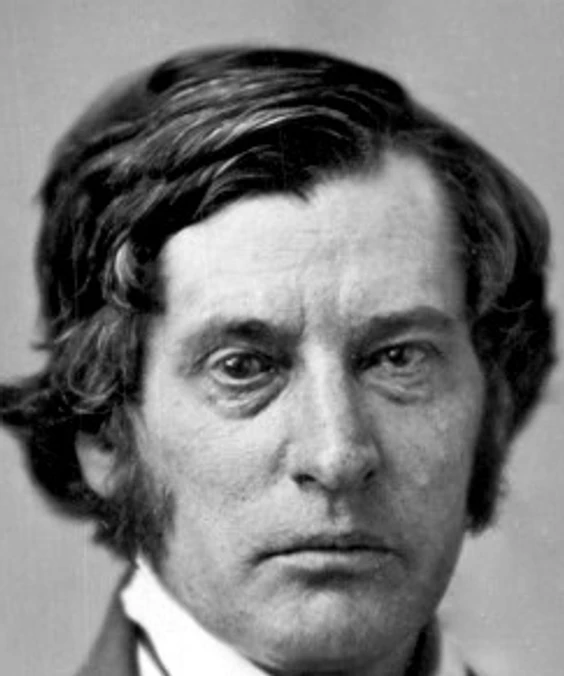
The conclusion, then, is irresistible, that when you come to the boundary line between a slave state and a free state, you come to the boundary line of slavery itself.
Horace Mann
The Public Record
Horace Mann was an American educational reformer, abolitionist and Whig politician known for his commitment to promoting public education; he is thus also known as The Father of American Education. In 1848, after public service as Secretary of the Massachusetts State Board of Education, Mann was elected to the United States House of Representatives (1848–1853). From September 1852 to his death in 1859, he served as President of Antioch College.
gutenberg.org
The inference is inevitable, that if the inhabitants of the fifteen slave states can carry slaves into California by virtue of the laws of their respective states, then they must also carry all the incidents of slavery known to their…
It is a right in every owner of ten slaves, that no man who does not own ten slaves, (or some legal equivalent,) shall be a member of the legislature.
In South Carolina, the ownership of ten slaves constitutes a property qualification for being a member of the legislature.
Now, how can a Georgian import slaves into California from Georgia, when the very laws of his own state, under which he claims to hold slaves, and under which laws he claims to carry slaves with him, forbid their importation?
Again; if the master carries into California the legal right to hold slaves, which he possessed at home, does not the slave also retain his legal rights when he is transferred there?
Individuals retain their citizenship on going there, as they do on going to Great Britain, or France; but a slave has just as much right to a portion of the public lands in California, when he gets there, as his master.
This argument appeals to the crime which the law was enacted to prevent, in order to establish the supremacy of the crime over the law that forbids it.
The law came in to regulate homicide; to authorize the taking of human life for crime, just as we authorize involuntary servitude for crime; and it may just as well be argued that murder is a natural right because it existed before law, as…
Homicide existed before law; the law came in subsequently, and declared that he who took an innocent man’s life without law, should lose his own by law.
I know it is said that the fact of slavery always precedes the law of slavery; that law does not go before the institution and create it, but comes afterwards to sanction and regulate it.
For, if slavery can be carried into any of our territories by force of the constitution, it can into all of them; and if carried into all of them, the exception becomes the rule, and the rule perishes.
Freedom is the rule, slavery is the exception.
As the constitution, in terms, adopts the common law, it leaves slavery nothing to stand upon but the local laws of the states where it is established.
These considerations demonstrate that slaves are not property, within the meaning of this word, when it is affirmed that if the north can carry its property into the territories, so can the south.
Why did it not provide for the capture of a fugitive horse or ox?
Then it is permitted on the simple ground that so much of the common law as secures liberty and property, the right of habeas corpus and freedom of speech to each individual, has been cut out and cast away.
Like lotteries, or polygamy, or infanticide, it can legally exist in no land where the principles of the common law prevail, until it is legalized and sanctioned by a special law.
The reason is that the law of slavery is a local law.
Just as well, I answer, and on precisely the same legal ground that the south can carry slavery into New Mexico.
Or, suppose, in pursuance of the “manifest destiny” principle, we should re-annex a part of China to this Union, could the Chinese, on removing to California, carry the practice of infanticide with them?
If any state in this Union had adopted polygamy as its peculiar institution, could an inhabitant of that state take a dozen wives with him into the new territories, and defend his claim to live with them there, because he could do so at…
Why, sir, there is not a respectable village in the country, where, if a juggler or mountebank were to attempt to palm off upon his audience so flimsy a trick as this, he would not be hissed from the stage.
Because we can carry our property there, when property means inanimate substances, you have only to call a human being property;--you have only to call a creature, formed in the image of God, property, and then he can be smuggled in under…
And then, forsooth, because we can carry property there, when property means grain and cattle, you can carry property there when it means human beings,--perhaps your own brothers, or sisters, or children.
Politicians like Horace Mann