What is to prevent the easy escape of slaves living within these limits?
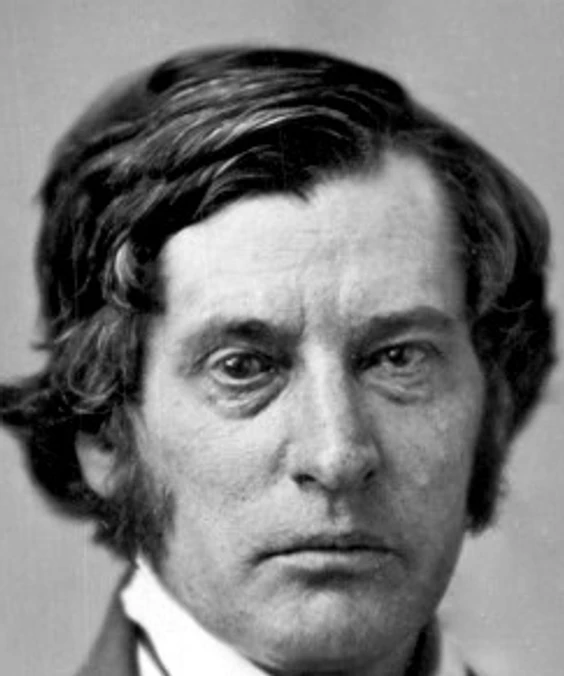
Horace Mann
The Public Record
Horace Mann was an American educational reformer, abolitionist and Whig politician known for his commitment to promoting public education; he is thus also known as The Father of American Education. In 1848, after public service as Secretary of the Massachusetts State Board of Education, Mann was elected to the United States House of Representatives (1848–1853). From September 1852 to his death in 1859, he served as President of Antioch College.
gutenberg.org
Beyond those limits, “No more slave territories, no more slave states,” is the doctrine by which I, for one, shall live and die.
I trust that no pictures and no realities will ever induce us to extend slavery beyond its present limits.
And what is the object for which we are willing to make this awful sacrifice?
Ten foreign wars,” it has been well said, “are a luxury compared with one civil war.” But I turn from this scene with a shudder.
If the two sections of this country ever marshal themselves against each other, and their squadrons rush to the conflict, it will be a war carried on by such powers of intellect, animated by such vehemence of passion, and sustained by such…
Threats of dissolution, if executed, become rebellion and treason.
And do those gentlemen who make these threats soberly consider how deeply they are pledging themselves and their constituents by them?
But gentlemen of the south not only argue the question of right and of honor; they go further, and they tell us what they will proceed to do if we do not yield to their demands.
So far is this from truth, that if you would promptly and cheerfully consecrate the new territories to freedom, every nation in the world would send their plaudits of your conduct to the skies.
I would agree to submit the question now at issue between the north and the south to the arbitrament of any people on the face of the earth, not absolutely savage, and to abide its decision.
A monarchy hails the advent of a free nation in Africa, where slavery existed before; a republic is seeking to create ten thousand absolute despotisms in America, where freedom existed before.
By this act, freedom secures a new domain on the eastern continent, while you are striving to give a new domain to bondage on the western.
Liberia, a republic of emancipated slaves, the very brothers and sisters of those whom you now hold in bondage, has been acknowledged as an independent sovereignty, and welcomed into the family of nations, by two of the most powerful…
France, in one fervid moment of liberty, struck the chains from off all her slaves, as the bonds of Paul and Silas were loosed in the inner prison by the mighty power of God.
However erroneous, then, their language or their sentiments may be, they are not affrontive nor contumelious; and, when all such purpose is disavowed, those who aspire to stand on the footing of gentlemen cannot reiterate the charge.
They wish to expostulate, in regard to the wrong, in such a way as to arrest the wrong, and not, by inflaming the wrongdoer, to increase the evil.
Their hostility to slavery grows out of an honest allegiance to what they believe to be the highest moral and religious duty; it is fortified by the opinions of mankind; and is perfectly compatible with the most fraternal feelings towards…
Now, it is infinitely far from the purpose of the north to offer any indignity to the south by excluding slavery from the territories.
We are told that the exclusion of slavery from the territories is an affront to the honorable sensibilities of the south; and that acquiescence in this exclusion would involve their dishonor and degradation.
Having, as I trust, refuted the argument of the slaveholder, that the prohibition of slavery in the territories is an act of injustice to his rights, I will consider his next assertion, that it is an insult to his feelings.
On its very face, the constitution meets this pretension with a denial.
So neither Virginia, nor all the fifteen slave states combined, can extend their slave laws one hair’s breadth into the new territories; and for the same reason,--the territories are beyond their jurisdiction.
Virginia cannot extend her laws one hair’s breadth over the line into Pennsylvania or into Ohio, because their soil is beyond her jurisdiction.
On one side of the line, down to the nadir and up to the zenith, the blackness of the slave code pervades all things; but, on the other side, as high above and as deep below, is the purity of freedom.
Politicians like Horace Mann