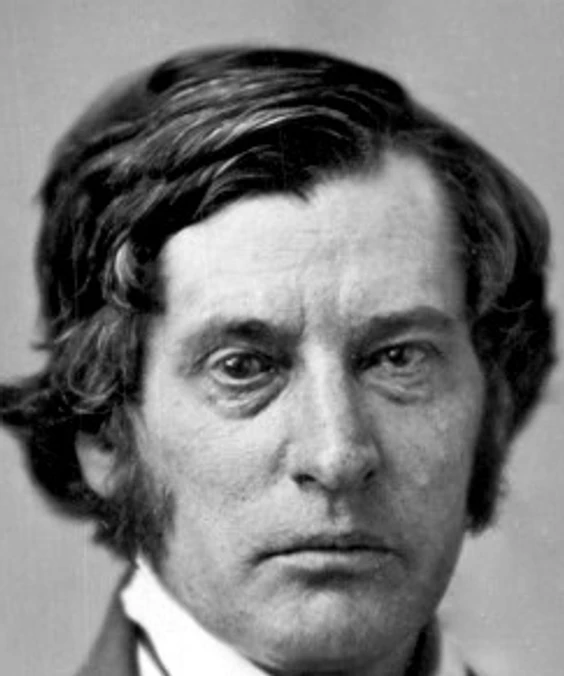
If popular views change, they change, “like a wave driven with the wind and tossed;” like a chameleon, changing its color with every contact.
Horace Mann
The Public Record
Horace Mann was an American educational reformer, abolitionist and Whig politician known for his commitment to promoting public education; he is thus also known as The Father of American Education. In 1848, after public service as Secretary of the Massachusetts State Board of Education, Mann was elected to the United States House of Representatives (1848–1853). From September 1852 to his death in 1859, he served as President of Antioch College.
gutenberg.org
No matter whether the tide ebbs or flows, they drift with the current.
Finding where the preponderance of forces lies, they attach themselves to the stronger.
The second class look eagerly beyond family or caste.
Even if practically right, therefore, they are never rationally right, for they have never discerned between good and ill; and all their convictions, whether true or untrue, rest upon the foundation of bigotry alone.
They never venture to explore or wander outside of the ideas and opinions among which they were born and bred.
There are those who adopt with implicit and unquestioning faith the views of their parents, or of the circle, or caste, into which they were thrown by the accident of birth.
Though all Young Men are substantially alike in their desire of well being, yet, in regard to the guiding principles by which the objects of hope are pursued, in order to obtain happiness, three marked distinctions, or classes, exist among…
All great moral questions, though touching them but lightly at first, will come closer and closer home, as long as they live;--growing into greater importance for their posthumous memory than for their living fame, and affecting the…
In these, therefore, their interest is both public and personal;--it pertains to the citizen as well as to the man.
The emulous and aspiring youth of a Free People will always find much of their private, and most of their public welfare, indissolubly connected with the institutions and laws of their country.
The desire of some form of happiness being secured, as a motive power, it seems to have been left very much to the option of each individual to select his own objects of enjoyment, whether noble or ignoble, and to devise his own means for…
Hence a fitting occasion presents itself for the statement of a few principles, by whose unerring guidance the exulting Hopes of Youth may always be transformed into the happy Memories of Age.
Politicians like Horace Mann