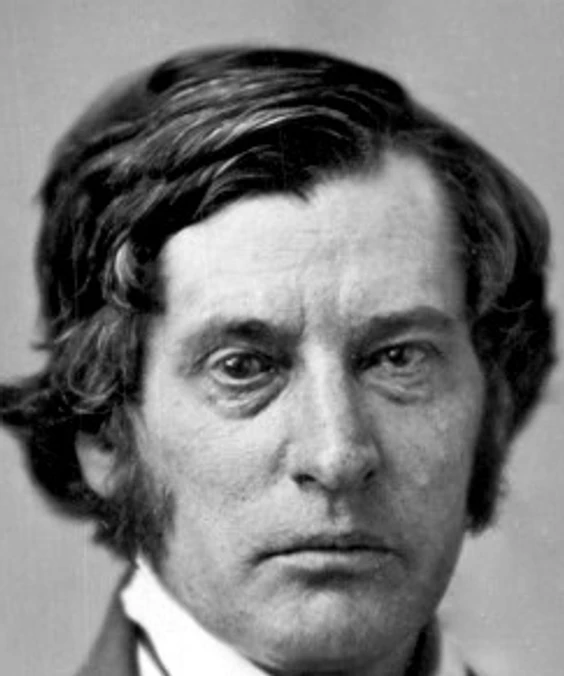
Such, sir, are the sights that molest us when we come here from the north,--that molest us in the hotels, that molest us in the streets, that molest us in the courts, that molest us every where.
Horace Mann
The Public Record
Horace Mann was an American educational reformer, abolitionist and Whig politician known for his commitment to promoting public education; he is thus also known as The Father of American Education. In 1848, after public service as Secretary of the Massachusetts State Board of Education, Mann was elected to the United States House of Representatives (1848–1853). From September 1852 to his death in 1859, he served as President of Antioch College.
gutenberg.org
If all the rights of the black race are thus withheld from them, it is just as certain as the progress of time that they, too, will have their Runnymede, their Declaration of Independence, their Bunker Hill, and their Yorktown.
Are they forever to wear a “wolf’s head,” which every white man may cut off when he pleases?
Is a whole race to be forever doomed to this outlawry?
Where, for them, is the Magna Charta that the old barons wrested from King John?
In the courts of law; in the temples with which all our ideas of justice, of right between man and man, are associated; where truth goes to be vindicated, where innocence flies to be avenged,--in these courts, an entire portion of the…
If introduced there at all, it is as a bale of goods is introduced, or as an ox or a horse is brought within their purlieus, for the purpose of trying some disputed question of identity or ownership.
However atrocious the wrongs they may suffer in their own person and character, or in the person and character of wife or children, they cannot appeal to the courts to avenge or redress them.
A yellow complexion here is so common a badge of slavery, that one whose skin is colored by disease is by no means out of danger.
I have seen members of this House to whom I have been disposed to give a friendly caution to keep their “free papers” about their persons, lest suddenly, on the presumption from color, they should be seized and sold for runaway slaves.
You do not need their color to remind you of their degradation.
They demonstrate that the one race has been to the other, not the object of benevolence, but the victim of licentiousness.
In the complexion of the slave, we read the horrid history of the guilt of the enslavers.
Multitudes of the slaves of the south bear about upon their persons a brand as indelible as that of Cain; but the mark has been fastened upon them, not for their own crimes, but for the crimes of their fathers.
But one thing I could never understand,--why those who are so horror-stricken at the idea of theoretic amalgamation, should exhibit to the world, in all their cities, on all their plantations, and in all their households, such numberless…
I would give to every human being the best opportunity I could to develop and cultivate the faculties which God has bestowed upon him, and which, therefore, he holds under a divine charter.
This is the lowest standard of duty that any one who aspires to be a Christian or a gentleman can set up for his guidance.
This maxim is my principle of action, whenever I am called upon to act; and it rises spontaneously to my contemplations when I speculate upon human duty.
I have been taught from my earliest childhood that “all men are created equal.” This has become in me not merely a conviction of the understanding, but a sentiment of the heart.
It is like that species of injustice where a man is compelled by a tax to support a religion which he disbelieves, and to pay a hierarchy whom his conscience compels him to denounce.
It wounds our moral and religious sensibilities, because we believe the institution to be cruel towards men, and sinful in the sight of Heaven; and yet we are made apparently to sanction it.
This is unjust to us, because it places us before the world in the attitude of sustaining what we condemn.
While slaves exist in it, therefore, it can be charged upon the north that they uphold slavery.
Having power of exclusive legislation over it, we are all responsible for the institutions in it.
But whatever may be said in mitigation or in condemnation of slavery elsewhere, there are special reasons why it should be discontinued in this District.
Politicians like Horace Mann