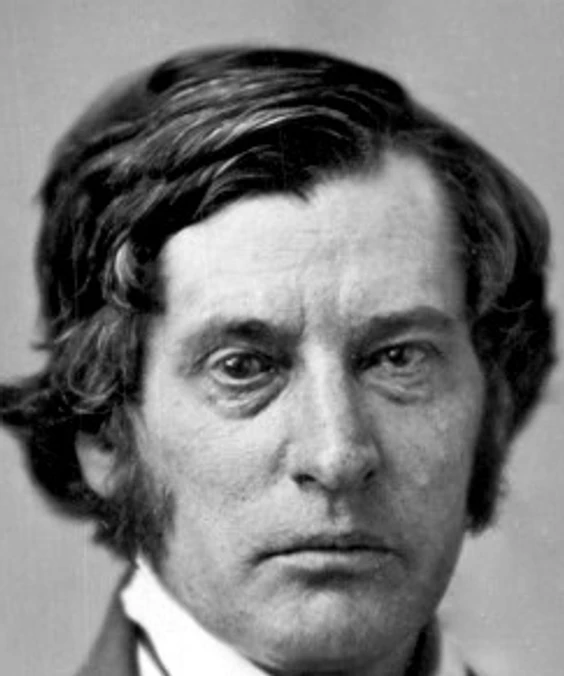
Now, it is in this way that some of the Christian attributes of character, being directly convertible into money or money’s worth, enhance the value of a slave.
Horace Mann
The Public Record
Horace Mann was an American educational reformer, abolitionist and Whig politician known for his commitment to promoting public education; he is thus also known as The Father of American Education. In 1848, after public service as Secretary of the Massachusetts State Board of Education, Mann was elected to the United States House of Representatives (1848–1853). From September 1852 to his death in 1859, he served as President of Antioch College.
gutenberg.org
If the master trains the slave to take care of his own children, or of his favorite animals, then he wishes to have him kind; but if he trains him for a tasker or a field overseer, then he wishes to have him severe.
But if he desires to make use of him to deceive and cajole and defraud, then he wishes to make him cunning and tricky and false.
If a master wishes to repose personal confidence in his slave, he desires to have him honest and faithful to truth.
There are certain virtues and sanctities which increase the pecuniary value of certain slaves; and there are certain vices and debasements which increase the market price of others.
How are slaves made better, and from what motives are they made better, in this country?
There are some blessings which the goodness of God will bestow in spite of human efforts to intercept them.
If any light penetrates to his soul, it is because human art cannot weave a cloud dense and dark enough to be wholly impervious to it.
All the good that reaches him, reaches him in defiance of these privations and disabilities.
By day and by night, at all times and every where, he is the victim of an energetic and comprehensive system of measures, which blot out his senses, paralyze his mind, degrade and brutify his nature, and suppress the instinctive workings…
On every highroad patrols lie in wait to scourge him back if he attempts to visit father, mother, wife, child, or friend, on a neighboring plantation.
Look through the southern statute books, and see what Draconian penalties are inflicted for teaching a slave to read,--see how he is lashed for attending a meeting to hear the Word of God.
But not one thing is done to bring out the qualities of manhood that lie buried in a slave.
Laws, judicial decisions, the writing of political economists,--all treat the slave as a thing to make money with.
In all the southern statute books, and legislative records, there is no trace of any such scheme.
Has their improved condition resulted from any purposed plan, any well-digested, systematized measure, carefully thought out, and reasoned out, and intended for their benefit?
If American slaves are better off than native Africans, who is to be thanked for it?
But there is another inquiry which the champions of slavery have got to answer before the world and before Heaven.
He would only have shown the difference between a “good Samaritan” and a “bigot Samaritan.” The thieves themselves might have done as much.
Suppose the Samaritan had bound up a single wound, or relieved a single pang of the bleeding wayfarer who had fallen among thieves, and then had gone to the next inn and boasted of his benevolence.
If a fellow-being is suffering under a hundred diseases, and we can relieve him from them all, what kind of benevolence is that which boasts of relieving him from one, and permits him to suffer under the other ninety and nine?
What standard of morals do gentlemen propose to themselves?
Is it enough if you have made the condition of a man or of a race a little better, or any better, if you have not made it as much better as you can?
The country might not have had so gaudy and ostentatious a civilization as at present, but it would have had one infinitely more pure and sound.
If the south had not had slaves to do their work for them, they would have become ingenious and inventive like the north, and would have enlisted the vast forces of nature in their service,--wind, and fire, and water, and steam, and…
Politicians like Horace Mann