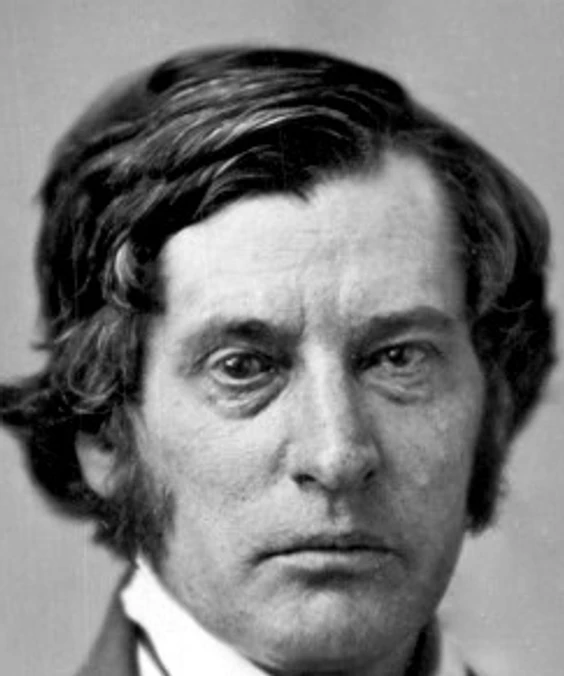
I saw, then, as I had never seen before, what a vital and inextinguishable interest every human being has in this subject;--not the slaves alone, but the free men; not voters only, but all who can be affected by votes; not men only, but…
Horace Mann
The Public Record
Horace Mann was an American educational reformer, abolitionist and Whig politician known for his commitment to promoting public education; he is thus also known as The Father of American Education. In 1848, after public service as Secretary of the Massachusetts State Board of Education, Mann was elected to the United States House of Representatives (1848–1853). From September 1852 to his death in 1859, he served as President of Antioch College.
gutenberg.org
If the legal relations of slavery did not sustain the moral ones, as the root sustains the branches and nourishes the fruit, those moral relations would seem to demand all our attention.
O, who can paint a sunbeam to the blind, Or make him feel a shadow with his mind?
A man must have a heart before he can feel, as he must have eyes before he can see.
Can we suppose that God has not planted the instinct of a mother’s love too deep to be destroyed but by the destruction of the being herself in whom it was planted?
And are we to expect that the brutalized, chattelized “cattle” of the south will have less of that natural yearning and longing of the soul, at the loss of their offspring, than the animals of the farmer’s yard?
I appeal to all history to prove, that no judge who ever sat upon a bench where the common law was recognized and administered, however corrupt he may have been, ever advanced a more atrocious doctrine.
Next to honesty, this fear is the greatest protection to property, liberty, and life.
The fear of this cross-examination “casting its shadows before,” has prevented thousands and tens of thousands from swearing falsely.
Without this right, there is no fraud that cannot be practised upon the most honest man, and no guilt that cannot be proved against the most innocent one.
If there be any one right known to the common law more important and sacred than all others, it is the right of confronting and cross-examining the witnesses who are brought to testify against us.
But UNTIL, mark this, =UNTIL= a man has been proved to be a slave by freeman’s proof, he remains legally free.
How then can any one of us freemen be robbed of liberty and property, and turned into a slave, but by freeman’s proof,--that is, trial by jury?
Notwithstanding the commissioner’s decision makes us all slaves, yet I maintain that, in the eye of the law, we are all free.
Through all the gradations, from the person who has the preternatural whiteness of an Albino to one whom you can see in the darkest midnight, because he is so solid black,--all, all, under our constitution and laws, are alike freemen, or…
I dismiss this point with a single proposition: In Massachusetts, we know no legal distinction founded on color.
Now fill up the space between them with what you please, and call it argument, law, gospel, or what you will, every body must see that it is nothing, and can be nothing but Mephistophiles’ jugglery.
These men have been deprived of liberty and property without the jury trial.
No man shall be deprived of liberty or property, except by the jury trial.
Adam Gibson, Henry Long, Thomas Sims, and many others, some of them now acknowledged on all hands to have been free, have been sent into slavery without this trial.
How can a man be proved, in any legal way, to have committed a crime, without being confronted with the witnesses against him?
But as though this was not absurd enough, the commissioner goes on to say, that though the alleged fugitive from justice must be proved, in the place where he is taken, “to have committed a crime,” yet, after his removal, he must be proved…
It is the alleged slave who must be proved to be held to service before he can be constitutionally surrendered.
He says that, to authorize the delivery of a fugitive from justice, in order to his removal, “it must be proved that he has committed a crime.” Such a declaration was never made before, and I do not believe it will be ever made again.
The law is beneficent to them; it saves its terrors for the slave.
Politicians like Horace Mann