But the receiver of an alleged fugitive from service owns him, and may proceed to control him, and beat him, and rob him, and starve him, on the very instant that the commissioner puts the certificate into his hands.
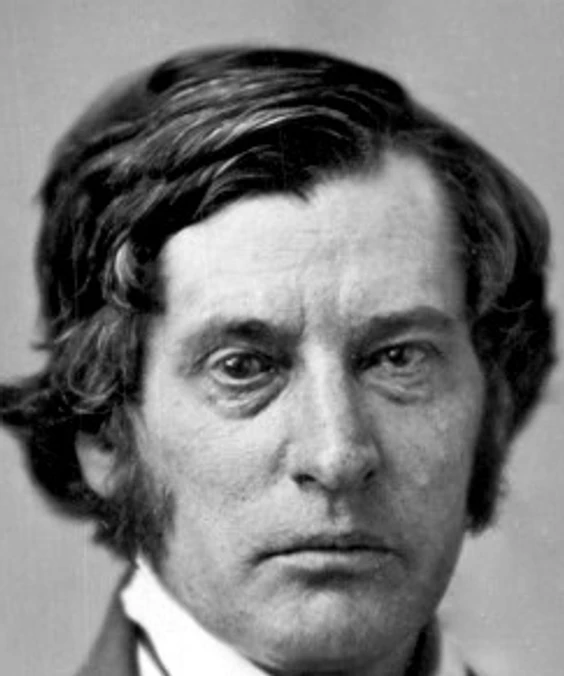
Horace Mann
The Public Record
Horace Mann was an American educational reformer, abolitionist and Whig politician known for his commitment to promoting public education; he is thus also known as The Father of American Education. In 1848, after public service as Secretary of the Massachusetts State Board of Education, Mann was elected to the United States House of Representatives (1848–1853). From September 1852 to his death in 1859, he served as President of Antioch College.
gutenberg.org
But the alleged fugitive from service is adjudged a slave, and made a slave by the certificate of the commissioner.
An alleged fugitive from justice is not adjudged to be a criminal previous to delivery, nor is he made a criminal, in the eye of the law, by the act of delivery.
The government demanding a fugitive from justice seeks possession of him for a trial, before a court and jury, of the question of criminality; but the claimant of an alleged fugitive from service seeks possession of him to avoid a trial…
Such reasonable suspicion of guilt as justifies a grand jury in finding a bill of indictment is sufficient in the one case, but such positive proof as would require the court to enter up judgment and award execution is absolutely necessary…
Where could he find a bandage of prejudice thick enough to blind him to the distinction, that the condition of delivering up the former is that he be charged with crime, while the condition of delivering up the latter is that he be held to…
Webster cajoled and cozened so many honest men, when he assured them, that though they should violate the moral law, by opening all the territories to slavery, yet some physical law of geography or the weather would avert the penalties.
Let them classify it and denounce it, and detest it, as belonging to that impious and blasphemous kind of arguments by which our first parents were beguiled, when Satan told them that, though they sinned against God, they should not die…
But to send a man to be worked to death in five years on a sugar plantation, where his being taught to read the gospel of Jesus Christ is a felony,--this is “special and limited,” and so may be done by any hireling commissioner who will do…
He declares that James Potter owns Thomas Sims, and the posterity in his loins forever; or that Thomas Sims and his posterity forever, owe service to James Potter and his heirs and assigns forever.
The commissioner declares a prima facie freeman to be a slave.
The constitution says, “No state shall pass any law impairing the obligation of contracts.” Here we have a constitutional basis,--the same as for the reclamation of fugitive slaves.
But in a technical and juridical sense the decision of the commissioner is final; and he might as well doom a man to be hurled from the Tarpeian rock, and say that the act is not final, because he only commits the victim to the laws of…
The whole argument of the commissioner, that this act of his is not final, is founded on a quibble,--on the use of the legal word “final,” as though it were synonymous with the popular word eternal or perpetual.
Besides the inhumanity of this position, it contains a fallacy which is twin-brother to the one just considered.
The premises he starts with are unknown to the constitution, and the conclusion he comes to is abhorrent to humanity.
Indeed, the whole argument of the commissioner on this point is but a play upon words.
The sublime power of a court becomes nothingness, and is ridiculous, if its decrees cannot be executed to the very death of the party against whom they are made.
Such an officer, under either constitution, would be a monster; he would hold the same relation to their legitimate functionaries that Caliban does to the human race; and, if created for executing the Fugitive Slave law, that half devil…
In both these constitutions, the three functions of government, namely, to legislate, to adjudicate, and to execute, are expressly recognized; and the whole of their distinctive powers are lodged in separate departments.
By this constitution, all legislative powers therein granted are vested in Congress; executive power in a President, and judicial power in the courts.
But we have a written constitution, and therefore are not to tolerate a law, (as in the case of this Fugitive Slave law,) which is repugnant to its fundamental provisions.
Great Britain, having no written constitution, the current of its legislative enactments and its judicial decisions makes its constitution.
The act which, in the first part of the opinion, was acknowledged to belong, “in the strictest sense,” to the “judicial power,” has now ceased to be “any thing more than a summary ministerial proceeding.
If the trial of the issue, “fugitive slave or not,” be, “in the strictest sense,” “within the express delegation of judicial power given” by the constitution, then this ministerial commissioner cannot exercise it, and Congress cannot…
Politicians like Horace Mann