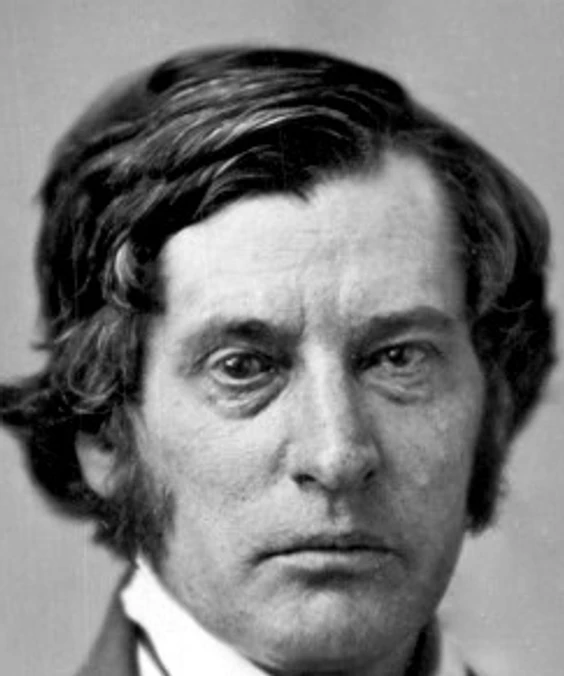
And how does he answer the first one, which, at a blow, unseats him from his usurped bench?
Horace Mann
The Public Record
Horace Mann was an American educational reformer, abolitionist and Whig politician known for his commitment to promoting public education; he is thus also known as The Father of American Education. In 1848, after public service as Secretary of the Massachusetts State Board of Education, Mann was elected to the United States House of Representatives (1848–1853). From September 1852 to his death in 1859, he served as President of Antioch College.
gutenberg.org
I now come to a position in the commissioner’s argument which is not only transparently fallacious, but is contradicted by himself, in the same opinion, again and again.
Who could have imagined, eight months ago, that a ministerial proceeding could put a citizen beyond remedy or reach of our courts?
The discussion may be dry, but it will not be uninteresting; for it involves matters as important as the liberty of the body and the liberty of the will, and the liberty and life of the human soul.
I never feel so confident of my conclusions as when strong men have taken the opposite side, and have failed to sustain it.
I take the Quaker ground upon this subject; I will not assist to execute it, though I shall suffer it to execute itself on me.
And next, I hold this law to be contrary to the constitution of the United States, and therefore of no binding force upon my conscience or my conduct.
He that refuses them, disobeys every precept of the Savior, and has no more right to call himself a Christian, than has the Fejee islander, when he rises from his cannibal banquet.
He that refuses the common acts of hospitality to these victims, when fleeing from their bondage, denies his Lord and Master.
And what confinement was ever so hopeless as southern slavery, what prison was ever so deep as that prison-house which holds three millions of our fellow-beings within its melancholy walls,--them and their posterity forever?
And who so hungry as those who do not own, and cannot own a morsel of bread?
In his dread description of the judgment day, Jesus Christ makes the distinction between saints and sinners to turn upon the fact, whether they have fed the hungry, clothed the naked, and visited those who were sick and in prison.
First, I believe it to be contrary to the law of God, which, God helping me, shall be the rule of my conduct, though I should scatter political treasons as the autumn wind scatters leaves.
Now, I have two objections to this law, which absolve me from all obligations to execute it, or, in any way or manner, to assist in executing it.
It is a living monster, uncaged and turned loose amongst us, to rob and devour at its will.
This enactment, too, is no theoretic affair; it is no dead letter on the statute book.
No lover of liberty can read them without having their atrocious character burned into his mind ineffaceably.
It is in this spirit that they have discussed and mean to discuss the Fugitive Slave law, and to bring it, Protestant fashion, to the test of individual judgment and conscience.
But with this sentiment of reverence for law is another sentiment, which is its proper attendant and brother,--I mean a desire and a determination to know what that is which is called law; what it is that claims this prerogative of…
And I trust the time is not now, and never will be, when the children of the Puritans will obey any commandment of human origin if it conflicts with a divine command, though they have to lie down in lions’ dens or walk through furnace…
The exception I mean, embraces those laws of men which are clearly contrary to the law of God.
This side of a just cause for revolution, they will yield submission to all laws enacted by the government, with one single exception.
If northern leaders had dishonored instead of indorsing this spurious paper, it never would have got into circulation.
I say, then, if the union of these states ever has been in any proximity to danger, it was not from menaces uttered by the south, but from northern indorsement of them.
Let the greatest coward see that his threats are acknowledged as verities, and he will adopt the cheap mode of threatening instead of the hazardous one of acting.
Politicians like Horace Mann