To say that the seat of such a law is in the “bosom of God,” is the intensest blasphemy.
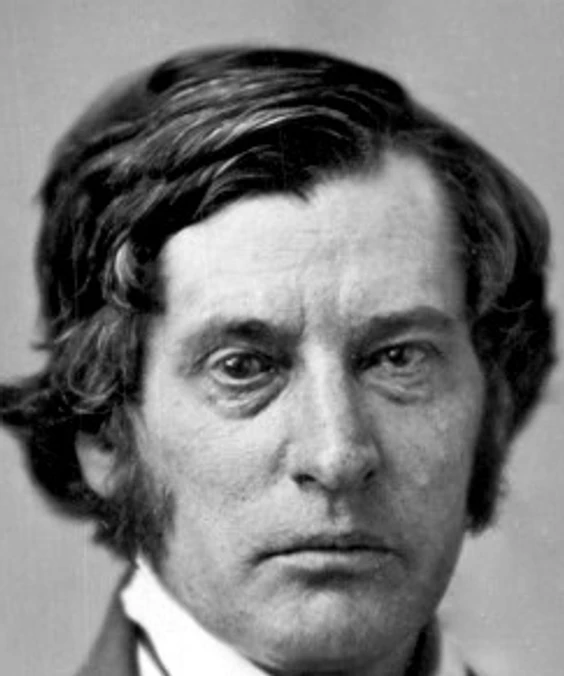
Horace Mann
The Public Record
Horace Mann was an American educational reformer, abolitionist and Whig politician known for his commitment to promoting public education; he is thus also known as The Father of American Education. In 1848, after public service as Secretary of the Massachusetts State Board of Education, Mann was elected to the United States House of Representatives (1848–1853). From September 1852 to his death in 1859, he served as President of Antioch College.
gutenberg.org
Now, sir, with these glorious attributes of “law,” I say the Fugitive Slave law of the last session possesses not one quality in common, nor in similitude.
Because the advocates and defenders of this law have been compelled to place its defence upon the express ground that the commandments of men are of higher authority than the ordinances of God.
Because it is a law which forbids us to do unto others as we would have them do to us, and which makes it a crime to feed the hungry, to clothe the naked, and to visit and succor the sick and the imprisoned.
Because it is a law which disgraces our country in the eyes of the whole civilized world, and gives plausible occasion to the votaries of despotic power to decry republican institutions.
Because it is a law which, if executed in the free states, divests them of the character of free states, and makes them voluntary participators in the guilt of slaveholding.
Because the life and character of so many of its apologists and supporters are themselves potent arguments against whatever they may advocate.
Because it is a law which is abhorrent to the moral and religious sentiments of a vast majority of the community that is called upon to enforce it.
Because it is a law which introduces a fatal principle into the code of evidence, and into judicial practice,--a principle, before which no man’s liberties and no man’s rights of any kind can stand.
Because it is a law which conflicts with the constitution of the country, and with all the judicial interpretations of that constitution, wherever they have been applied to the white race.
Because it is a law which wars against the fundamental principles of human liberty.
In the name of my constituents, and by the memory of that “old man eloquent,” in whose place it is my fortune to stand, I demand its repeal.
And now, sir, when I am called upon to support such a law as this, or to desist from opposing it in all constitutional ways, while it lasts, my response is, repeal the law, that I may no longer be called upon to support it.
But the words of a preacher do not “come mended from his tongue,” when his name is a scandal among men for his violation of all the precepts he enjoins.
I do not cite the above cases from among a thousand similar ones, as any justification or apology for forcible and organized resistance to law by those who even constructively can be said to have given it their consent.
For which practice have our cities been conspicuous,--for their obedience to these laws or for their violation of them?
Is not money lent in all those cities on the same principle that wreckers send a rope’s end to a drowning man,--for as much as they can extort?
Are the men in New York, in Philadelphia, and Boston, who are most vehement in support of the Fugitive Slave law, signalized for their regard to the statutes against usury?
Can the class of men who demand our allegiance to the Fugitive Slave law stand this test?
It bestows its greatest homage upon those laws that embrace and confer the most of human welfare; for, were all the laws of a community, or the great majority of them, unrighteous, then disloyalty to law would be the virtue.
Under the pretext of rendering unto Cæsar the things that are Cæsar’s it denies to God the things that are God’s.
It is but an appeal to the lower rule of action to justify a violation of the higher.
How can a man pretend to any honest regard for the principle of obedience to law when he is willing, as in the case of this fugitive act, to transcend our constitutional law, and to invade the divine law?
In answer to this call, let me say, that true obedience to law is necessarily accompanied and preceded by a reverence for those great principles of justice and humanity without which all law is despotism.
And it is this very class of men who have thus abjured the precepts of Jesus Christ, who have trampled upon the divine doctrines of liberty and love, that now so clamorously summon us to an obedience to law.
Politicians like Horace Mann