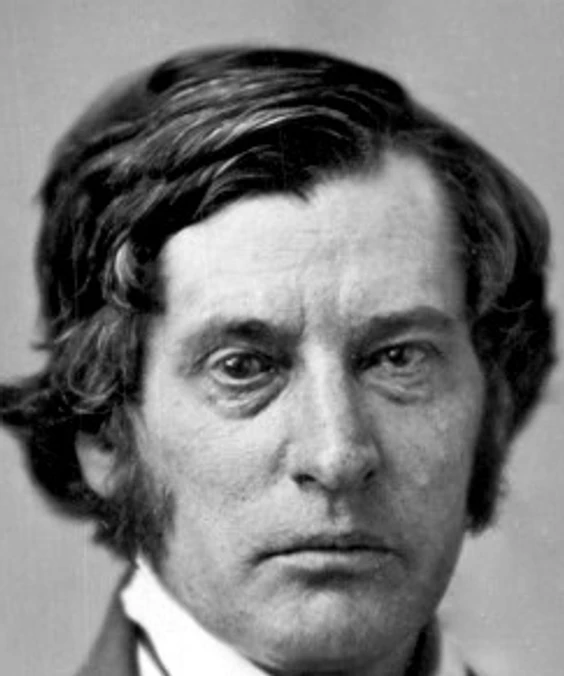
From selfish considerations, from the love of wealth, or the love of power, they have discarded that heaven-descended maxim, “Whatever ye would that men should do unto you, do ye the same unto them.
Horace Mann
The Public Record
Horace Mann was an American educational reformer, abolitionist and Whig politician known for his commitment to promoting public education; he is thus also known as The Father of American Education. In 1848, after public service as Secretary of the Massachusetts State Board of Education, Mann was elected to the United States House of Representatives (1848–1853). From September 1852 to his death in 1859, he served as President of Antioch College.
gutenberg.org
Why, then, if they would do this to avert such peril from themselves and their families, do they not do it when their sable brethren are in jeopardy?
Christian and Infidel, Jew and Gentile, would execrate it alike.
The name of every man who had voted for it, or who should defend it, would be entered upon that apostate list at whose head stands the name of Judas.
I say, sir, it is the population of African descent in the free states which is specially put in peril by this law.
Cause and counsellor are alike; for the defence is as profligate as the act it defends.
Yet the atrocities of this law are defended by those who made it, on the ground that they and other white men have secured benefits to themselves by sacrificing the liberty, happiness and peace of half a million of their fellow-beings of a…
I say it with reverence, but I still say it with emphasis, that we cannot conceive of God himself as having power to inflict vicarious suffering without the free consent of the sufferer!
Who gave them the terrible prerogative of making others suffer for their pleasure.
Who authorized the law-makers to derive a benefit to themselves from doing this infinite wrong to others?
The whites, north and south, played a game, and made the black people their stakes.
And these interests were given away by men who did not own them, and therefore had no right to transfer them.
A mere barter of the holiest interests for worldly advantages!
The Fugitive Slave law was passed, and thereby the rights of freemen, the property of men in themselves, all the household sanctities, all the domestic endearments of half a million of men, were put in peril.
They look outside of it for pretexts to hide its inherent baseness; but not one of them, so far as I know, has had the effrontery to justify it on its intrinsic merits.
I do not recollect the instance of a single northern man or northern press, utterly false to freedom, and venal as so many of them have been, that has expressed entire satisfaction with the law.
Now, this principle applies with tenfold force to legislators,--withholding and repelling them from passing any law which may involve the innocent in the fate of the guilty, or the free in the bondage of the enslaved.
I aver, that before any moral tribunal, where right and wrong are weighed in the balances of the sanctuary, there is not a felony described in the whole statute book that is more felonious than such a law.
An awful decree! second in terribleness only to that which shall divide between the blessed and the accursed before the judgment-seat of God.
Now, after this debased class has been created by a wicked system of human laws, and after it is mingled with the free class, another law steps in and decrees that the former shall be remanded to their bondage.
It is the noble privilege of a Massachusetts man to say, that, as all men are equal before the divine law, so are all men equal within our borders, before the human law.
In some of the states, as in Massachusetts for instance, the law knows no iota of distinction, in any respect, between a black man and a white man; between one of European and one of African descent.
Their freedom is guarantied to them by the constitution of the United States, and by the constitutions and laws of the states respectively in which they dwell.
They possess, as fully as you or I, those prerogatives of freedom without which life ceases to be a blessing.
Yet, though it is expressly declared that Congress cannot vest any part of the judicial power of the United States in a state court, the state courts are empowered by this law to take and certify evidence, which is made “conclusive” in the…
Politicians like Horace Mann