Contrary to this, however, the supreme court has said, “Congress cannot vest any portion of the judicial power of the United States except in courts ordained and established by itself.”--Martin vs.
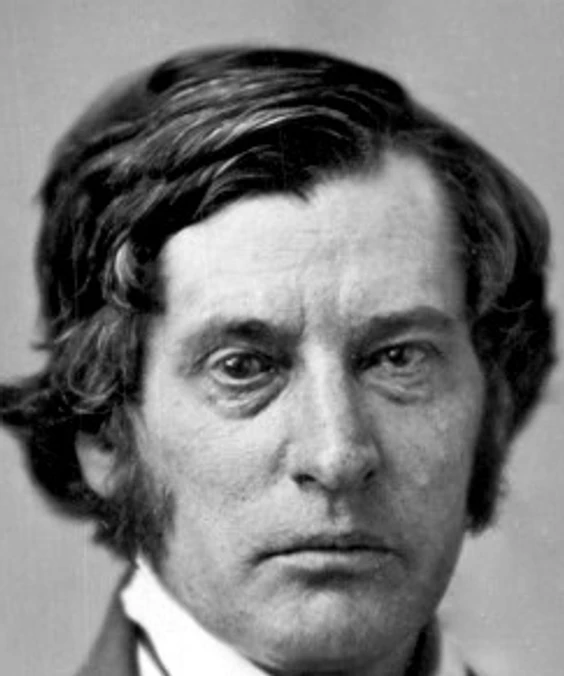
Horace Mann
The Public Record
Horace Mann was an American educational reformer, abolitionist and Whig politician known for his commitment to promoting public education; he is thus also known as The Father of American Education. In 1848, after public service as Secretary of the Massachusetts State Board of Education, Mann was elected to the United States House of Representatives (1848–1853). From September 1852 to his death in 1859, he served as President of Antioch College.
gutenberg.org
Now, he who has power to take and authenticate evidence, which it is predetermined shall be “conclusive” in the case, has power to decide the case.
If the claimant of James Hamlet could be supplied with a force, at the government’s expense, to carry him into slavery, why should not the expense of coming back into a land of freedom be reimbursed by the government to Adam Gibson, after…
There is no clause, or phrase, or word in that instrument which favors the idea that the Northern States should bear the expense, as well as the disgrace, of thus remanding our fellow-men into bondage.
Then, why should government interpose in this case to bear costs and risks, unless slavery is so meritorious an institution as to deserve the benefactions as well as the benedictions of freemen?
Mark another particular in which the provisions of the law go beyond the requirements of the constitution.
The region is continental over which the law unconstitutionally extends, and this corresponds with the vast inhumanity of the principle which so extends it.
Now let any one take a map of the United States, and see over what a vast area the law extends, over which the provision in the constitution does not extend.
Four classes of cases are provided for by the law, while but one of them finds any warrant in the constitution.
Yet the sixth section of the act provides not only for the case of slaves escaping from one state into another state, but for their escape from a state into a territory, and for an escape from a territory into a state, and for an escape…
The expression, “No person held in one state, escaping into another TERRITORY,” would be not merely ungrammatical and un-English, but nonsensical.
It must mean state, and can mean nothing else; for the laws of language admit no other construction.
Yet the Fugitive Slave law contains provisions which there can be no pretence nor shadow of a pretence that the constitution requires.
And the same legal maxims, in regard to all subjects touching life and liberty, bind Congress in legislating under the constitution, as bind the judicial tribunals in administering the law.
These have become maxims, or axioms, of legal interpretation; and in their long and unbroken recognition, it is not too strong an expression to say, they impetrate and command a strict construction of that clause in the constitution under…
They have held that provisions against life and liberty should be strictly construed, while those in favor of life and liberty should be liberally construed,--the one so construed as to inflict as little of pain and privation as possible…
All judges of an honorable name, all courts in all civilized communities, have recognized a broad distinction in the principles of interpreting law.
The main and primary object of the constitution was to protect natural rights; but the object of the Fugitive Slave clause was to protect a legal right in conflict with natural right.
However clear the constitutional obligation of Congress to enact a law for the reclamation of fugitive slaves may be supposed by any one to be, there certainly are limitations to this obligation, which all the principles of our government…
The great and free republic of North America has transferred the unwritten law of Judge Lynch to its statute book.
Overstepping the acts of the common tyrant, there is an infliction of the most heinous wrong, with a premeditated purpose that it shall not be repaired.
The witnesses who swore away his liberty may have been perjured, but he cannot stop to convict them.
Swift and sure as an arrow to its mark, he is speeded on his way to the abodes of toil and despair.
The murderer is allowed a season of respite between the hour of sentence and the hour of death; the debtor may turn out goods to satisfy a creditor’s demands; but the alleged fugitive has no reprieve.
A great portion of these outcasts from human justice, I doubt not, are better prepared for the summons of instantaneous death than for this summons of instantaneous trial.
Politicians like Horace Mann