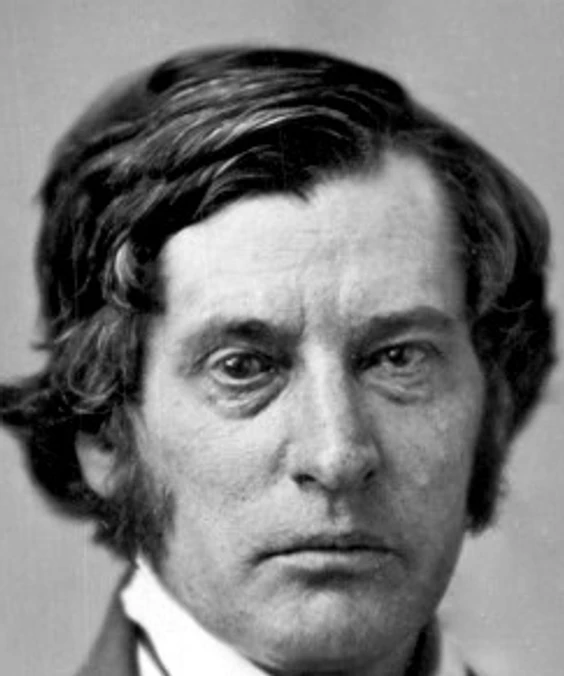
It is only in the land of slaves that they are blotted out and annihilated.
Horace Mann
The Public Record
Horace Mann was an American educational reformer, abolitionist and Whig politician known for his commitment to promoting public education; he is thus also known as The Father of American Education. In 1848, after public service as Secretary of the Massachusetts State Board of Education, Mann was elected to the United States House of Representatives (1848–1853). From September 1852 to his death in 1859, he served as President of Antioch College.
gutenberg.org
No savage nation, however far removed from the frontiers of civilization, has ever yet been discovered, where these rights were unknown or unhonored.
What rights are more sacred or more dear to us than the conjugal and the parental?
This is the reciprocity of slave law.--to be forever liable to be proved guilty, but never able to prove himself innocent; to be subject to all punishments, but, through his own oath, to no protection.
He may suffer all wrong, and the courts will not hearken to his testimony; but for the first wrong he does, the same courts inflict their severest punishments upon him.
And yet, infinitely flagrant as the anomaly is, the slave is amenable to the laws of the land for all offences which he may commit against others, though he is powerless to protect himself by the same law from offences which others may…
The law denies the slave a character; for, however traduced, legal vindication is impossible.
How dearly does every honorable man prize character!
There is not one of the fell passions that rages in his bosom which he cannot indulge with wantonness and to satiety, and the court has no ears to hear the complaint of the victim.
The wickedest white man, in a company of slaves, bears a charmed life.
A hundred of his fellows may stand around him and witness the wrongs he suffers, but not one of them can appeal to jury, magistrate, or judge, for punishment or redress.
So far as legal rights against his oppressors are concerned, the slave lives in such a world of darkness.
Into what infinite forms of violence and wrong would the depraved passions of the human heart spring up, when no longer restrained by the light of day, and the dangers of exposure!
Suppose, suddenly, by some disastrous change in the order of nature, an entire kingdom or community were to be enveloped in total darkness,--to have no day, no dawn, but midnight evermore!
The wife may be dishonored in the presence of the husband, and, if he remonstrates or rebels, the miscreant who could burn with the lust will burn not less fiercely with a vengeance to be glutted upon his foiler.
The father, who is a slave, may see son or daughter scored, mangled, mutilated, or ravished before his eyes, and he must be dumb as a sheep before its shearers.
For personal cruelties, for stripes that shiver his flesh, and blows that break his bones, for robbery or for murder, neither he nor his friends can have preventive, remedy, or recompense.
To suffer injury is his, but never to obtain redress.
While subjected to the law of force, he is shut out from the law of right.
But all these sacred protections are denied to the slave.
The slave is debarred from testifying against a white man.
For another reason slavery is an unspeakable wrong.
Would to God that this could ever be said of his fellow-victims in America!
The slave infant must be taught to walk, or how, under the shadow of this thrice-glorious Capitol, could he join a coffle for New Orleans?
The slave child must be allowed to use his limbs, or how could he drudge out his life in the service of his master?
Politicians like Horace Mann