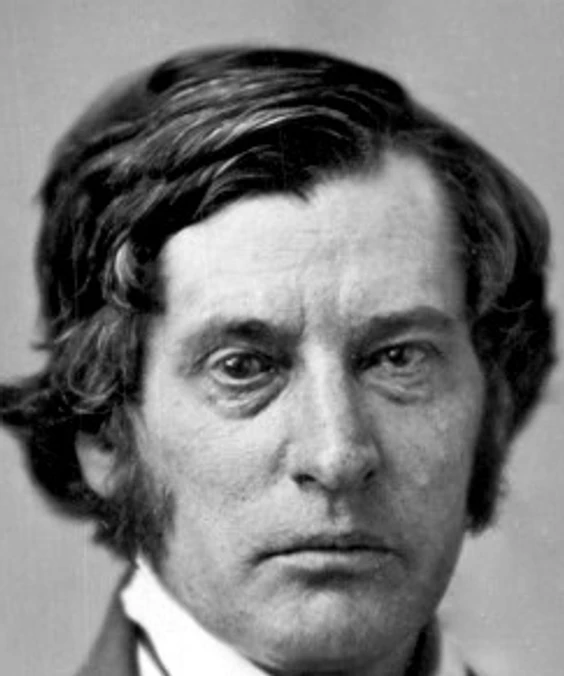
These were generally industrious and enterprising white men, who found, by sad experience, that a country of slaves was not the country for them.
Horace Mann
The Public Record
Horace Mann was an American educational reformer, abolitionist and Whig politician known for his commitment to promoting public education; he is thus also known as The Father of American Education. In 1848, after public service as Secretary of the Massachusetts State Board of Education, Mann was elected to the United States House of Representatives (1848–1853). From September 1852 to his death in 1859, he served as President of Antioch College.
gutenberg.org
Many of these multitudes, who have left the slave states, have shunned the regions of slavery, and settled in the free countries of the west.
Her black children have sucked her so dry, that now, for a long time past, she has not milk enough for her offspring, either black or white.
Her lowland neighbors of Maryland and the Carolinas were not far behind at the seeding; nor are they far behind at the ingathering of desolation.
Old Virginia was the first to sow this land of ours with slavery; she is also the first to reap the full harvest of destruction.
It were hard to find, in old king-ridden, priest-ridden, overtaxed Europe, so large a country, where, within twenty years past, such a growing poverty and desolation have appeared.
Not war, nor pestilence; not oppression of rulers, civil or ecclesiastical; but slavery, a curse more destructive in its effects than any of them.
On the old slave-labored lowlands, a singular phenomena has appeared; there, within the bounds of these rapidly growing United States,--yes, there, population has been long at a stand; yes, over wide regions,--especially in Virginia,--it…
Even cold, barren New England, though more than twice as thickly peopled, grew in population at a faster rate than these old slave states.
In the older free states are seen all the tokens of prosperity;--a dense and increasing population; thriving villages, towns, and cities; a neat and productive agriculture, growing manufactures, and active commerce.
No man of common sense, who has observed this result, can doubt for a moment that the system of free labor promotes the growth and prosperity of states in a much higher degree than the system of slave labor.
Here the two systems have worked side by side for ages, under such equal circumstances, both political and physical, and with such ample time and opportunity for each to work out its proper effects, that all must admit the experiment to be…
Nowhere, since time began, have the two systems of slave labor and free labor been subjected to so fair and so decisive a trial of their effects on public prosperity as in these United States.
It is proposed not to break old fetters and cast them away, but to forge new ones and rivet them on.
Yet it is this very religious despotism over millions of men which it is now proposed, not to destroy, but to create.
Yet it was only for this right of private judgment, for this independence of another man’s control in religious concernments, that the godlike champions of religious liberty perilled themselves and perished.
Who does not reverence, I say, Wickliffe, Huss, Luther, and the whole army of martyrs whose blood reddened the axe of English intolerance?
Who so base as not to reverence the mighty champions of religious freedom, in days when the dungeon, the rack, and the fagot were the arguments of a government theology?
Yet, by denying education to the slave, you destroy not merely the right, but the power, of personal examination in regard to all that most nearly concerns the soul’s interests.
I am interested in nothing else so much as in the attributes of my Creator, and in the relations which he has established between me and himself, for time and for eternity.
The dearest and most precious of all human rights is the right of private judgment in matters of religion.
If one of these coördinate powers in the mental realm be annulled by the legislature, it may be called law; but it is repugnant to every law and attribute of God.
But the impious hand of man divorces these twin capacities, wherever it denies knowledge.
Mere knowledge, without the moral sense, can take no cognizance of the everlasting distinctions between right and wrong; and so the blind instinct, unguided by knowledge, will be forever at fault in its conclusions.
Slavery is an unspeakable wrong to the conscience.
Politicians like Horace Mann