It is not until the fields grow old, and the crops grow short, and the negroes and the overseer take nearly all, that the day of ruin can be no longer postponed.
Horace Mann
The Public Record
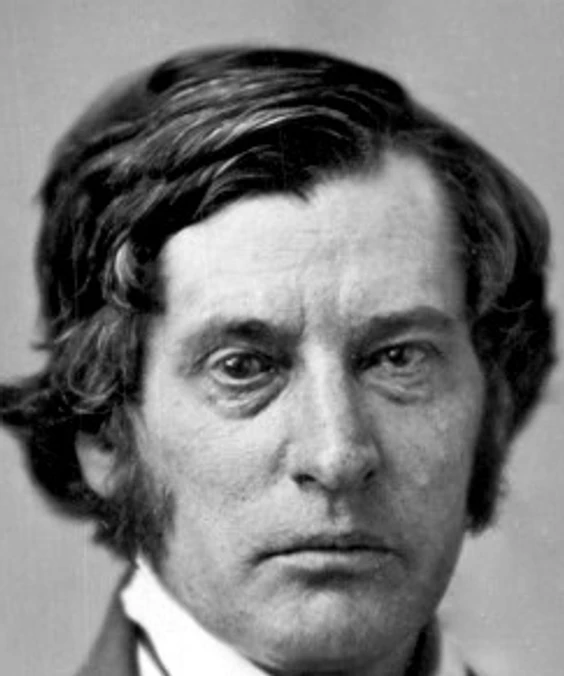
Horace Mann was an American educational reformer, abolitionist and Whig politician known for his commitment to promoting public education; he is thus also known as The Father of American Education. In 1848, after public service as Secretary of the Massachusetts State Board of Education, Mann was elected to the United States House of Representatives (1848–1853). From September 1852 to his death in 1859, he served as President of Antioch College.
gutenberg.org
When a white family own fifty or one hundred slaves, they can, so long as their land produces well, afford to be indolent and expensive in their habits; for though each yields only a small profit, yet each member of the family has ten or…
We shall explain, by examples, how a few slaves in a country may do its citizens more immediate injury than a large number.
Answer: She is in a country in which slavery is established by law.
But again; seeing that Wheeling, as a seat for manufactures, is equal to Pittsburg, and inferior to no town in America, except Richmond; and that, moreover, she has almost no slaves; why is Wheeling so far behind Pittsburg, and…
Answer: They breathe the atmosphere of free states, almost touching them on both sides.
For this her citizens deserve to be crowned,--not with laurel,--but with the solid gold of prosperity.
We glory in Wheeling, because she only, in Virginia, deserves to be called a manufacturing town.
No state has greater conveniences for ship navigation and ship building than Virginia.
Or, to enlarge the scope of the question: What must you think has caused Virginians in general to neglect their superlative advantages for manufacturing industry?--to disregard the evident suggestions of nature, pointing out to them this…
Of all the states in this Union, not one has on the whole such various and abundant resources for manufacturing as our own Virginia, both East and West.
This can be attributed only to slavery, which paralyzes our energies, disperses our population, and keeps us few and poor, in spite of the bountiful gifts of nature with which a benign Providence has endowed our country.
In those parts only where the slaves are comparatively few, are many mechanics and artificers to be found; but even in these parts they do not flourish as the same useful class of men flourish in the free states.
The number of mechanics, in different parts of the south, is in the inverse ratio of the number of slaves; or in other words, where the slaves form the largest proportion of the inhabitants, there the mechanics and manufacturers form the…
Now, although mechanics, by setting up their shops in the south, could save all these freights and profits, yet so it is, that northern mechanics will not settle in the south, and the southern mechanics are undersold by their northern…
The northern freemen come with their ships, carry home the timber and pig iron, work them up, supply their own wants with a part, and then sell the rest at a good profit in the southern markets.
Pliny denounces, as the worst of all, the system of having large estates in the country cultivated by slaves, or indeed, says he, “to have any thing done by men who labor without hope of reward.
The same system was spreading ruin over the provinces, and thus the prosperity of the empire was undermined.
This ruinous system of large farms cultivated by slaves showed its effects in Italy, eighteen hundred years ago, when the Roman empire was at the height of its grandeur.
They cannot do otherwise with laborers who work by compulsion, for the benefit only of their masters, and whose sole interest in the matter is to do as little and to consume as much as possible.
The general system of slaveholding farmers and planters, in all times and places, has been, and now is, and ever will be, to cultivate much land, badly, for present gain,--in short, to kill the goose that lays the golden egg.
Agriculture in the slave states may be characterized in general by two epithets, extensive, exhaustive,--which in all agricultural countries forebode two things, impoverishment, depopulation.
He that chooses to employ a sort of labor that yields only half as much to the hand as another sort would yield, makes a choice that is not only unprofitable, but deeply injurious to his interest.
Therefore, since in agriculture slave labor is proved to be far less productive than free labor, slavery is demonstrated to be not only unprofitable, but deeply injurious to the public prosperity.
It is a truth, a certain truth, that slavery drives free laborers,--farmers, mechanics, and all, and some of the best of them too,--out of the country, and fills their places with negroes.
Politicians like Horace Mann