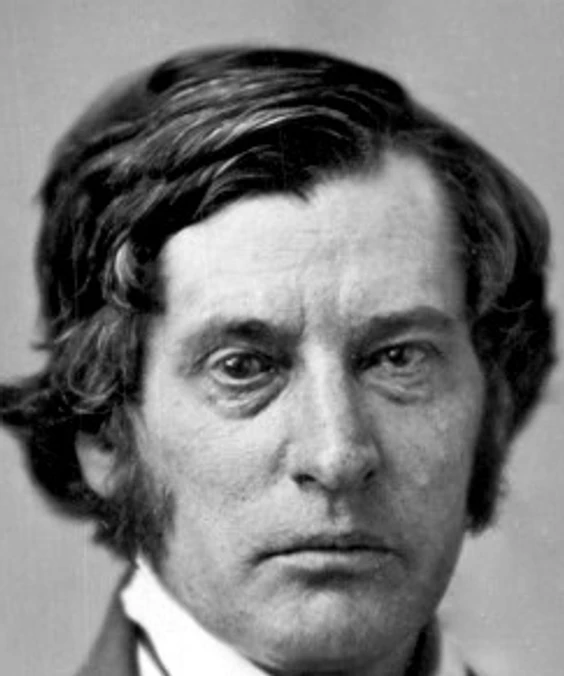
The heart, secure in its own convictions, closes itself against the argument that would overthrow them, as a fond parent bars his doors against the foe that would carry away his children.
Horace Mann
The Public Record
Horace Mann was an American educational reformer, abolitionist and Whig politician known for his commitment to promoting public education; he is thus also known as The Father of American Education. In 1848, after public service as Secretary of the Massachusetts State Board of Education, Mann was elected to the United States House of Representatives (1848–1853). From September 1852 to his death in 1859, he served as President of Antioch College.
gutenberg.org
And of all difficult positions in which advocate or orator was ever placed, the most difficult is that of encountering the honest antipathies of his hearers.
Hence it is natural, yes, it is inevitable,--is it not?--that we should approach this subject with widely different views, and, as it were, from opposite points of the moral compass.
On a subject of vast importance and gravity,--a subject reflected from every feature of this case,--I was born, and from my birth have been trained up, in one set of ideas; and I mean no discourtesy when I say that you have been born and…
We are within shaking-hands’ distance of each other; still, our convictions and sentiments on certain subjects may be wide asunder as the poles.
Our persons are near to each other; but should I not greatly deceive myself, were I to suppose that our opinions were as near together as our persons?
I cannot forbear to add, that it is a case, also, which, in some of its aspects, touches the deepest and tenderest sympathies of the human heart; for this prosecution not only deals with human beings as offenders, but with human beings and…
And this is independent of the question whether Congress, by the constitution, has any more right to establish slavery any where than it has to establish an inquisition, create an order of nobility, or anoint a king.
Slavery being against natural right, can only exist by virtue of positive law, backed by force sufficient to protect it.
Delay, not, then, we beseech you, to raise a barrier against this Stygian inundation, to stand at the Blue Ridge, and with sovereign energy say to this Black Sea of misery, “Hitherto shalt thou come, and no farther.
Whether you obtain it or not, East Virginia will have triumphed; or, rather, slavery will have triumphed, and all Virginia will have become a land of darkness and of the shadow of death.
We have shown how slavery has prepared the people for this; how a little slavery makes way for more, and how the law of slave increase operates to fill up every part of the country to the same level with slaves.
In plain terms, fellow-citizens, eastern slaveholders will come with their multitudes of slaves to settle upon the fresh lands of West Virginia.
The head spring in East Virginia cannot contain itself; it must find vent; it will shed its black streams through every gap of the Blue Ridge and pour over the Alleghany, till it is checked by abolitionism on the borders.
Cast it off, West Virginians, whilst yet you have the power; for if you let it descend unbroken to your children, it will have grown to a mountain of misery upon their heads.
But behold in the east the doleful consequences of letting slavery grow up to an oppressive and heart-sickening burden upon a community!
The fact is, that our eastern brethren must send off, on any terms, the increase of their slaves, because their impoverished country cannot sustain even its present stock of negroes.
The price of cotton has regulated the price of negroes in Virginia; and so it must continue to do; because slave labor is unprofitable here, and nothing keeps up the price of slaves but their value as a marketable commodity in the south.
Many who are unable to buy slaves leave it also, because they feel degraded, and cannot prosper, where slavery exists.
The result is, that many families are compelled by their embarrassments to sell off and leave the country.
Thus general industry gives way by degrees to indolent relaxation, false notions of dignity and refinement, and a taste for fashionable luxuries.
They infallibly grow and spread, creating among the white families a distaste for all servile labor, and a desire to procure slaves who may take all drudgery off their hands.
Such unthrifty sentiments are the natural consequence of introducing slaves among the families of a country, especially negro slaves.
When a white family own five or ten slaves, they cannot afford to be indolent and expensive in their habits; for one black drudge cannot support one white gentleman or lady.
But the ruin of small slaveholders is often accomplished in a single lifetime.
Politicians like Horace Mann