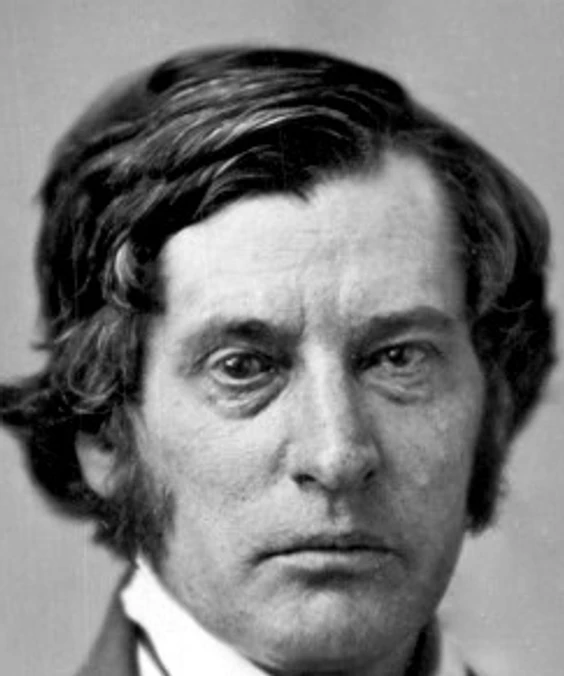
They find no warrant for it in the eternal principles of justice and equity; and in that great division which they set forth between right and wrong, they arrange slavery in the catalogue of crime.
Horace Mann
The Public Record
Horace Mann was an American educational reformer, abolitionist and Whig politician known for his commitment to promoting public education; he is thus also known as The Father of American Education. In 1848, after public service as Secretary of the Massachusetts State Board of Education, Mann was elected to the United States House of Representatives (1848–1853). From September 1852 to his death in 1859, he served as President of Antioch College.
gutenberg.org
The writers on moral or ethical science,--the expounders of the law of nations and of God,--denounce slavery as an invasion of the rights of man.
Jurists, from the time of Justinian; orators, from the time of Cicero; poets, from the time of Homer, declare it to be wrong.
The institution of slavery is against natural right.
If, therefore, there is any ingredient of wrong in this institution, we ought not to adopt it, or to permit it, even though it should pour wealth in golden showers over the whole surface of the land.
It is proposed not merely to continue this institution where it now exists, but to extend it to the Pacific Ocean,--to spread it over the vast slopes of the Rocky Mountains.
Let not southern men, who would now force slavery upon new regions, ever deny that their slavery at home is a chosen, voluntary, beloved crime.
But if they now insist upon perpetrating against the whole western world, which happens at present to be under our control, the same wrongs which, in darker days, Great Britain perpetrated against them, they will forfeit every claim to…
How often have we at the north been told that we were inciting insurrection, fomenting a servile war, putting the black man’s knife to the white man’s throat.
To drive coffles of slaves from here to Oregon, in the middle of the nineteenth century, is more infamous than it was to bring cargoes of slaves from Africa here, in the middle of the eighteenth.
So great has been the progress of liberal ideas within the last century, that what was venial at its beginning is unpardonable at its close.
It is in the nineteenth century that we propose to reënact, and on an ampler scale, the same execrable villany,--a time when liberty is the rallying cry of all Christendom.
If the execrations of mankind are yet too feeble and too few to punish Great Britain for her wickedness, what scope, what fulness, what eternity of execration and anathema will be a sufficient retribution upon us, if we volunteer to copy…
Great Britain annulled our laws for prohibiting slavery; we propose to annul an existing law of Oregon prohibiting slavery.
Yet it is now proposed, in some of the state legislatures, and in this Capitol, to do precisely the same thing, in regard to the Territory of Oregon, which was done by Great Britain to her transatlantic possessions; not merely to legalize…
Now, if the King of Great Britain prostituted his negative that slavery might not be restricted, what, in after times, shall be said of those who prostitute their affirmative that it may be extended?
Determined to keep a market where MEN should be bought and sold, he has prostituted his negative for suppressing every legislative attempt to prohibit or to restrain this execrable commerce.
This piratical warfare, the opprobrium of infidel powers, is the warfare of the CHRISTIAN King of Great Britain.
He has waged cruel war against human nature itself, violating its most sacred rights of life and liberty in the persons of a distant people who never offended him, captivating and carrying them into slavery in another hemisphere, or to…
The three millions of slaves that now darken our southern horizon are the progeny of these progenitors,--a doomed race, fated and suffering from sire to son.
During all those years, the clock of eternity never counted out a minute that did not witness the cruel death, by treachery or violence, of some son or daughter, some father or mother, of Africa.
And there, monsters of the land, fiercer and feller than any that roam the watery plains, rewarded the robber by purchasing his spoils.
The blue monsters of the deep became familiar with her pathway, and, not more remorseless than she, they shared her plunder.
Thousands and thousands of corpses, which she plunged into the ocean from the decks of her slave ships, she counted only as the tare of commerce.
Once a day the hatches were opened, to receive food and to disgorge the dead.
Politicians like Horace Mann