The free schools of the north lead to the common diffusion of knowledge, and the equalization of society.
Horace Mann
The Public Record
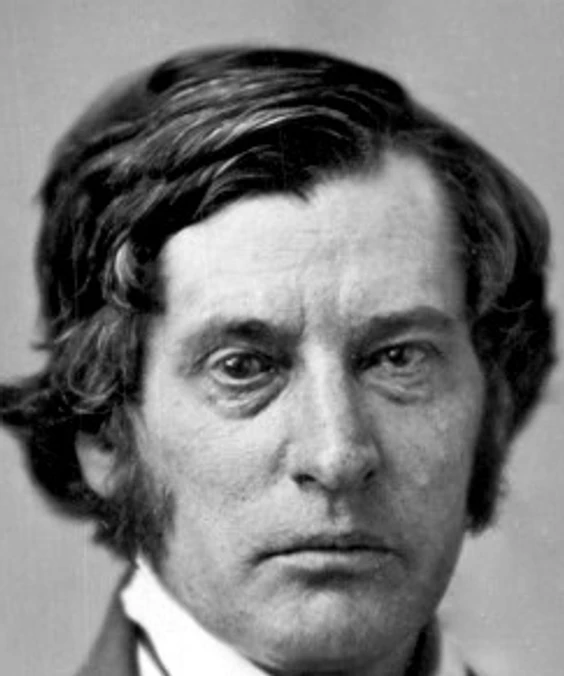
Horace Mann was an American educational reformer, abolitionist and Whig politician known for his commitment to promoting public education; he is thus also known as The Father of American Education. In 1848, after public service as Secretary of the Massachusetts State Board of Education, Mann was elected to the United States House of Representatives (1848–1853). From September 1852 to his death in 1859, he served as President of Antioch College.
gutenberg.org
And then, having made a waste where God had made a garden, slavery gathers up the relics of bankruptcy, and the baser relics still of virtue and all manly enterprise, and goes forth to renew, on a virgin soil, its dismal and forlorn…
Connected with this moral decay, the resources of nature also are exhausted, and her fertile territories changed to a desert, by the uncreating power of a spendthrift institution.
And if we ask for what is dearer and better still, for a pure Christian morality, the youth of slavery are trained in no such habits as are most congenial to virtue.
But how clearly is it seen to be a violation of its own laws, for slavery to produce a genuine scholar, or a man who, in any department of excellence, unless it be in politics, is not a full century behind his time?
We have come up now to a point where we look for true intellectual refinement, and a ripe state of personal culture.
The accomplishments it yields are of a mock quality, rather than of a real, having about the same relation to a substantial and finished culture that honor has to character.
And when it comes of self-indulgence, or only seeks relief for the tedium of an idle life, scarcely does it bring with it the blessings of a virtue.
But however highly we may estimate the humanizing power of hospitality, it cannot be regarded as any sufficient spring of character.
Education and religion thus displaced, the dinner table only remains, and on this hangs, in great part, the keeping of the social state.
Therefore, the ease it enjoys cannot but end in a curse, and the degradation it suffers cannot rise into a blessing.
It produces a condition of ease which is not the reward of labor, and a state of degradation which is not the curse of idleness.
Slavery is a condition against nature; the curse of nature, therefore, is on it, and it bows to its doom by a law as irresistible as gravity.
Meanwhile, the foster-sons of slavery,--the high families, the statesmen,--gradually receding in character, as they must under this vicious institution, are receding also in power and influence, and have been ever since the revolution.
Free labor is rising, at length, into a state of wealth and comfort, to take the lead of American society.
A class of statesmen were thus raised up, who were prepared to figure as leaders in scenes of public life, where so much depends on manners and social address.
It gives us, too, that sign which is the perpetual distinction of barbarism, that it has no law of progress.
Slavery, it is not to be denied, is an essentially barbarous institution.
Societies for preventing crime; for saving from pauperism; for the reform of prisons and the reformation of prisoners; for peace; for sending missionaries to the heathen; for diffusing the gospel,--all these, where a sound education is…
Diligence earns much, but the absence of the vices of indolence saves more.
Out of universal education come genius, skill, and enterprise, and the desire of bettering one’s condition.
Can any man give a reason why Norfolk should not have grown like New York, other than the difference in the institutions of the people?
The north comes to the south, cuts their timber, carries it home, manufactures it, and then brings it back, wrought into a hundred different forms, to be sold to those who would see it rot before their eyes.
In the New England states, the iron manufacture is twenty times as much, according to the population, as it is in Virginia; and yet Virginia has far more of the ore than they.
All such improvements come from minds which have had an early awakening, and been put on scientific trains of thought in their childhood and youth,--a thing utterly impossible for the people at large, without Common Schools.
Politicians like Horace Mann