Let those who aid, abet, or connive at slavery extension now, as they read the damning sentence which history has awarded against the actors, abettors, and connivers of the African trade, but change the names, and they will be reading of…
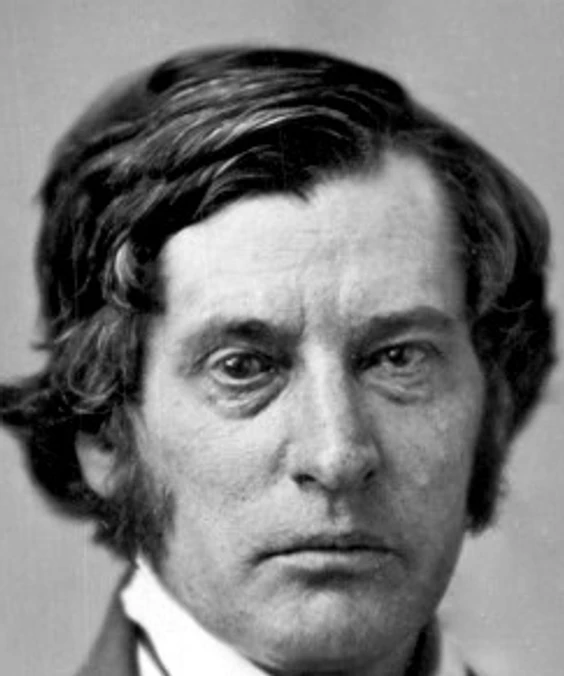
Horace Mann
The Public Record
Horace Mann was an American educational reformer, abolitionist and Whig politician known for his commitment to promoting public education; he is thus also known as The Father of American Education. In 1848, after public service as Secretary of the Massachusetts State Board of Education, Mann was elected to the United States House of Representatives (1848–1853). From September 1852 to his death in 1859, he served as President of Antioch College.
gutenberg.org
Are rich men forever to use their “thirty pieces of silver,” or their “ten thousand pounds sterling,” or their hundreds of thousands of dollars, to reward the Judases for betraying their Savior?
And is commerce, the daughter of freedom, thus forever to lift her parricidal hand against the parent that bore her?
It is said, that the corporation of Liverpool, at this time, “believed firmly that the very existence of the city depended upon the continuance of the traffic.” Look at Liverpool now, and reflect what greater rewards, even of a temporal…
If I am right, no one can complain; for we must all bow before the majesty of truth.
If I am wrong, I will not add to an error of judgment the meanness of a clandestine attack.
I have taken what seemed to me the more manly course; and if these views should ever by chance fall under his eye, I believe he has magnanimity enough to respect me the more for the frankness I have used.
But still I say, that the man who can read this bill without having his blood boil in his veins, has a power of refrigeration that would cool the tropics.
Webster spoke for the south and for slavery; not for the north and for freedom, when he abandoned this right.
A man may not lose a horse without a right to this trial; but he may his freedom.
Still further; this bill derides the trial by jury, secured by the constitution.
It all belongs to New Mexico, as much as Nantucket or Berkshire belongs to Massachusetts.
Now, on investigation, I believe it will most conclusively appear that there is not an inch of Texan territory north of the stipulated line.
If Texas meant to abide by the resolutions of annexation, and to claim any thing under them, it was her clear and imperative duty forthwith to pass a law, securing freedom to every inhabitant north of the compromise line.
In the “territory north of the Missouri compromise line, slavery or involuntary servitude, (except for crime,) shall be prohibited.” So reads the bond.
The resolutions themselves say, in express terms, that the new states are to be admitted “under the provisions of the federal constitution;” and the federal constitution says, “New states may be admitted by the Congress into this Union.”…
Though the annexation of Texas was in pursuance of a void stipulation, yet it is a clear principle of law, that when a contract void between the parties, has been executed by them, it cannot then be annulled.
We have made the foregoing remarks only to show, that, if any fair construction could show such a power to exist any where, or to be exercised in any form, yet the manner of its exercise now proposed is destitute of all decent semblance of…
According to our convictions, there is no power in any branch of the government, or all its branches, to annex foreign territory to this Union.
I know no mode of recognition that can add a tittle of weight to it.” Catching the tone of his asseveration, I respond that I know no form of statement, nor process of reasoning, which can make it more clear, that this is an absolute and…
When Texas and the south have got their slave states “to the number of four” into the Union, whence are we to obtain our one or more free states?
Webster have claimed the four states for freedom, with as sound logic and with far better humanity than he surrendered them all to slavery?
Is a slave state, which dooms our brethren of the human race, perhaps interminably, to the vassal’s fate, so insignificant a trifle, that it may be flung in, as small change on the settlement of an account?
What a bridal gift for the harlot of bondage!
He transfers a whole state, with all its beating hearts, present and future; with all its infinite susceptibilities of weal and woe, from the side of freedom to that of slavery, in the ledger book of humanity.
Politicians like Horace Mann