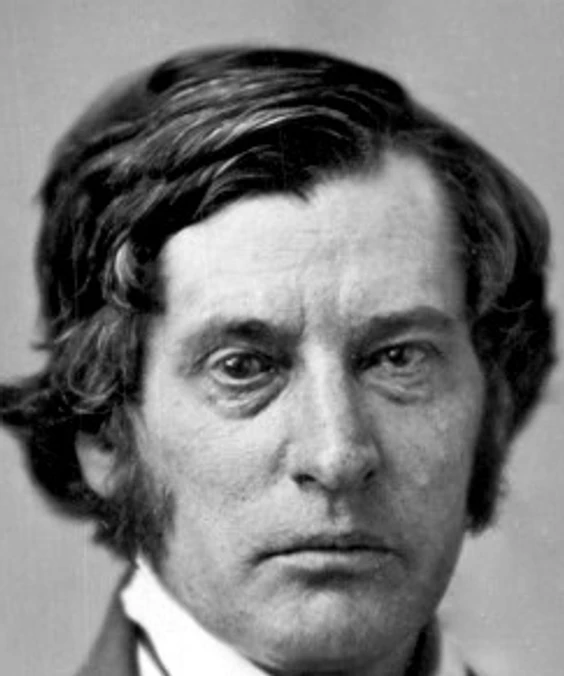
Slavery is introduced by man, and through his vice.
Horace Mann
The Public Record
Horace Mann was an American educational reformer, abolitionist and Whig politician known for his commitment to promoting public education; he is thus also known as The Father of American Education. In 1848, after public service as Secretary of the Massachusetts State Board of Education, Mann was elected to the United States House of Representatives (1848–1853). From September 1852 to his death in 1859, he served as President of Antioch College.
gutenberg.org
For human nature implores, without ceasing, for liberty.
That must necessarily be adjudged a cruel law, which augments slavery, and diminishes liberty.
The law of Nature,” says Blackstone, “being coeval with mankind, and dictated by God himself, is, of course, superior in obligation to any other.
Especially, when we are proposing to make or amend a law, ought we to take our gauge of purpose and of action from the highest standard.
I hold it to be not only proper, but proof of sound moral and religious feeling, to look to the perfect law of God for light to enable us more justly to interpret the imperfect laws of man.
I wish, however, to remark, that though I acknowledge the constitution to be my guide while under oath to support it, yet I do not relish this fling either at the powers above us, or at those who reverence them.
If the constitution requires me to do any thing which my sense of duty forbids, I shall save my conscience by resigning my office.
My ideas of duty require me to seek anxiously for the true interpretation of the constitution, and then to abide by it, unswayed by hopes or fears.
I deprecate error of all sorts; but hold it to be more venial to err in judgment than in heart.
Can any opinion be so false to the constitution, as this bill to humanity?
It furnishes endless temptations and facilities for committing wrong; it imposes no restraints; it warns by no threats of retribution.
Butler’s bill is, that it provides no penalty whatever for any one who shall abuse, or fraudulently use, the dangerous authority which it gives.
It is only because one needs “to tear a leaf from the curse-book of Pandemonium” in order to describe it by fitting epithets.
Now, if this bill does not “deride” all guaranties for the protection of human liberty, it is only because my word of reprobation is too weak.
The bill would have been far less disgraceful, had its provisions borne upon the men who should pass it; because, in such case, there would have been a touch of equality.
What aggravates the wrong, is, that the cruelties of the measure will fall upon the poor, the helpless, the ignorant, the unfriended.
Did oppression ever before conceive such a tribunal, so countless in numbers, so ample in jurisdiction, so terrible in power?
But if the alleged slave declares, here, in Massachusetts, that he owns himself, he is debarred from this right.
If two adverse claimants contest title to an alleged slave, whose market value is more than this sum, each is entitled to a jury to try the fact of ownership.
Does not this hold a man’s freedom to be of less value than twenty dollars?
I said a man may not lose his horse, or his property in a horse, without a right to the trial by jury.
Webster may pitch somersets with his own doctrines, but he has no right to pitch them with mine.
Webster’s comment is, that this case, “if it have any analogy to the matter,” means, that if a man’s horse “stray into his neighbor’s field, he cannot lead him back without a previous trial by jury to ascertain the right.” Was ever the…
But the opinion expressed by me on this point does not need the authority of any name to support it; and the illustration which I gave is not only intelligible to every sensible man, but is also apposite.
Politicians like Horace Mann