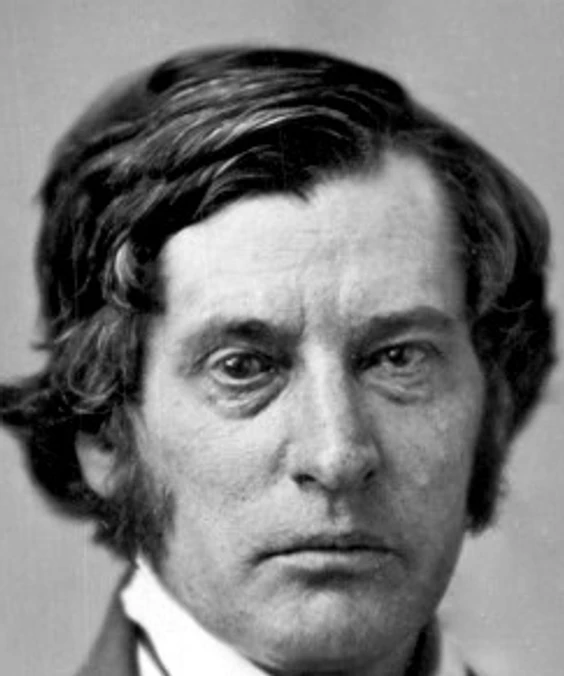
I protest against and impugn this method of proceeding, by any man, however high, against any man, however humble.
Horace Mann
The Public Record
Horace Mann was an American educational reformer, abolitionist and Whig politician known for his commitment to promoting public education; he is thus also known as The Father of American Education. In 1848, after public service as Secretary of the Massachusetts State Board of Education, Mann was elected to the United States House of Representatives (1848–1853). From September 1852 to his death in 1859, he served as President of Antioch College.
gutenberg.org
I must now, however, be permitted to add that the highest eminence becomes unenviable when it breeds intolerance of dissent, or bars out the humblest man from a free expression of opinion.
A man may not lose his horse without a right to this trial, but he may lose his freedom.
If, in the providence of God, we must be vanquished in this contest, let it be by force of the overmastering and inscrutable powers above us, and not by our own base desertion.
At Lexington, at Concord, and on Bunker Hill, the grass still grows greener where the soil was fattened with the blood of our fathers.
The idea that Massachusetts should contribute or consent to the extension of human slavery!--is it not enough, not merely to arouse the living from their torpor, but the dead from their graves!
My words have been cool as the telegraphic wires, while my feelings have been like the lightning that runs through them.
If both these hopes fail, our country is doomed to run its unobstructed career of conquest, of despotism, and of infamy.
It is, that New Mexico will do for herself what we shall have basely failed to do for her.
Let every lover of freedom do his best and his most.
A single vote may turn the scale, and Massachusetts may give that vote.
With these advantages, let us never aggress upon their rights, but let us maintain our own.
The south may rule the Union, but they cannot divide it.
Every new concession transfers strength from our side to the side of our opponents; and if we cannot arrest our own course when we are just entering the rapids, how can we arrest it when we come near the verge of the cataract?
If the territories are now surrendered, we shall have Cuba, and an indefinite career of conquest and of slavery will be opened on our south-western border.
The moral paralysis which failed to oppose the Mexican war, has given us the territories.
We are assailed now because we have yielded before.
Had the north stood firm, had they been true to the great principles they have so often and so solemnly proclaimed, the waves of southern violence would have struck harmless at their feet.
A surrender, therefore, by our northern business men, will be most disastrous to the very business that tempts them to surrender.
They will have nothing to sell but gold; they will have every thing to buy,--cradles and coffins, and all between.
Pecuniary surrenders I would gladly make for the sake of peace, but not for peace itself would I surrender liberty.
I mention this to prove that it is not the value, in money, of territorial freedom, for which I contend, but its value in character, in justice, in human happiness.
Public revenues I would appropriate, private taxation I would endure, to relieve this otherwise thrice-glorious republic from the calamity and the wrong of slavery.
Why can we not combine for the sacred cause of freedom, as they combine for slavery?
Are the children of darkness to be forever so much wiser than the children of light?
Politicians like Horace Mann