He makes a donation, a gratuity, of an entire slave state, larger than many a European principality.
Horace Mann
The Public Record
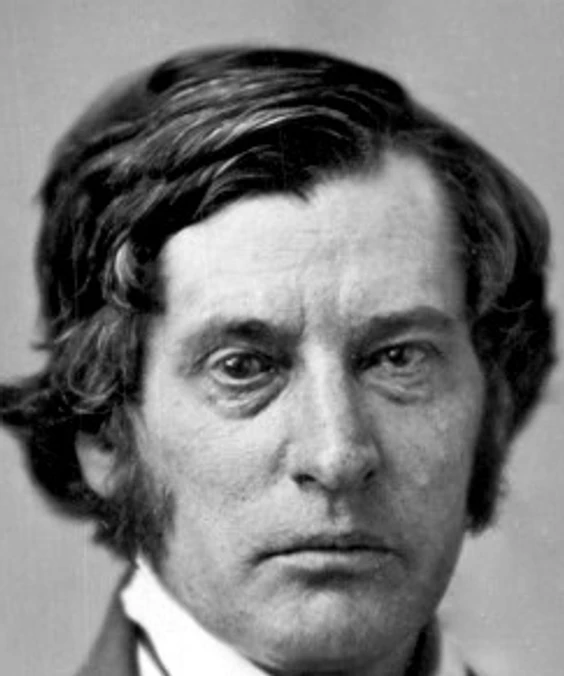
Horace Mann was an American educational reformer, abolitionist and Whig politician known for his commitment to promoting public education; he is thus also known as The Father of American Education. In 1848, after public service as Secretary of the Massachusetts State Board of Education, Mann was elected to the United States House of Representatives (1848–1853). From September 1852 to his death in 1859, he served as President of Antioch College.
gutenberg.org
Yet our fathers thought it no tampering with holy things to enact them; and, in times of struggle and peril, they have been to many a tempted man as an anchor to the soul, sure and steadfast.
Is it not a most grand and beautiful exposition of “the will of God,”--a transcript, as it were, from the Book of Life?
Look at that noble array of principles which is contained in the Declaration of Rights in the constitution of Massachusetts.
Cease to transcribe upon the statute book what our wisest and best men believe to be the will of God in regard to our worldly affairs, and the passions which we think appropriate to devils will soon take possession of society.
True, it is useless to put upon our statute books an astronomical law, regulating sunrise, or high tides; but that is physical and beyond the jurisdiction of man, while slavery belongs to morals, and is within the jurisdiction of man.
It is this: Endless doubts and contradictions exist among men, as to what is the will of God; and on no subject is there a wider diversity of opinion than on this very subject of slavery.
It has been well said that all law and all volition must be in harmony with the will of the Good Spirit, or with that of the evil one; and if we will not reënact the will of the former, then, either all legislation ceases, or we must…
As much as freedom is higher than tariff, so much stronger than their dissent should be ours.
I have discovered an irrepealable and irreversible law of nature, which overrules all the devices of men.
The south waged war with Mexico from one, and only one, motive; for one, and only one, object,--the extension of slavery.
Still, when the most precious interests of humanity are in peril, I would not be timid.
He is not a Christian whose humanity is bounded by the legal degrees of blood, or by general types of feature.
And by what rule of Christian morality, or even of enlightened heathen morality, can we deal differently with the kindred of others from what we would with our own?
Are we to submit a question of human liberty over vast regions and for an indefinite extent of time, to the determination of chance?
But suppose a doubt could be reasonably entertained about the invasion of the new territories by slavery.
If the cold of the higher latitudes checks the flow of African blood, or benumbs African limbs, the slaveholder knows very well that a trifling extra expense for whips will make up for the difference.
Webster, and hundreds of others indeed, instead of applying to intelligence offices, or visiting emigrant ships for “domestics,” as we call them, go at once to the auction room and buy a man or a woman with as little hesitancy or…
A state of slavery would not stop their respiration, nor cause them to vanish “into thin air.” Think, for a moment, of the complaints we constantly hear in certain circles, of the difficulty and vexatiousness of commanding domestic service.
Africans can exist here, for the best of all reasons,--they do exist here.
As a revelation from Heaven, it would be most delightful; but, as it conflicts with all human experience, it requires at least one undoubted miracle to attest the divinity of its origin.
I cannot accept the prophecy without inquiring what spirit inspired the prophet.
On a subject of such infinite importance I cannot be satisfied with a dictum; I want a demonstration.
Under such circumstances, is it frivolous or captious to ask for something more than a dogmatic assertion that slavery cannot impregnate these new regions, and cause them to breed monsters forever?
Do you believe that Daniel Webster himself could be returned if there was the least doubt upon the question?
Politicians like Horace Mann