Under our present relations, however, I do feel at liberty to use considerable plainness of speech.
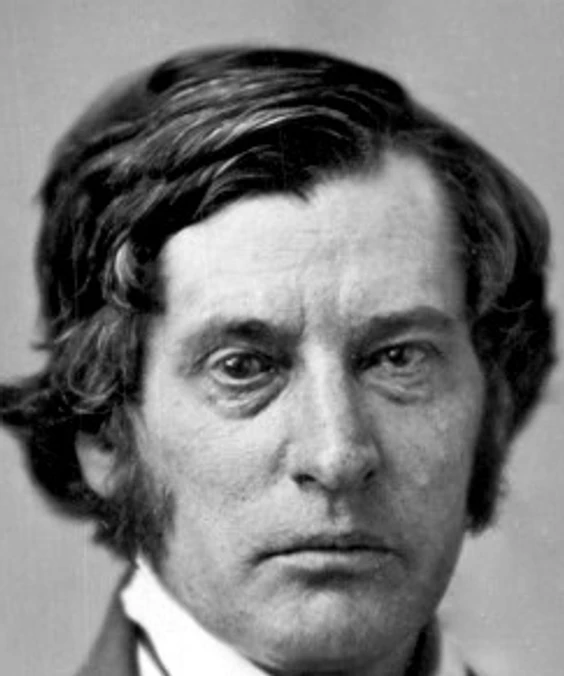
Horace Mann
The Public Record
Horace Mann was an American educational reformer, abolitionist and Whig politician known for his commitment to promoting public education; he is thus also known as The Father of American Education. In 1848, after public service as Secretary of the Massachusetts State Board of Education, Mann was elected to the United States House of Representatives (1848–1853). From September 1852 to his death in 1859, he served as President of Antioch College.
gutenberg.org
It is between truth and error; and just so certain as the spirit of Good will prevail over the spirit of Evil, just so certain will Truth ultimately triumph.
Blindness to the distinction between the value and the principle of property, and the value and the principle of liberty, could alone have permitted the comparison.
If I repose in contentment and indifference, because my own section, or state, or county, is as yet but a partial sufferer, why should I not continue contented and indifferent while I myself am safe?
Is this the Christian standard by which to estimate the evil of encroachments upon the most sacred rights of men?
Does not every body know that any man, who is capable of the enormous guilt of seizing or buying a freeman, will make it impossible for that freeman to regain his birthright?
Webster seems to think that as soon as a kidnapping slave dealer shall transport his human prey to the south, he will at once take him to, or allow him to go before a court of justice, or will sell him to some brother Samaritan who will do…
Webster says there are independent courts at the south, “always open and ready to receive and decide upon petitions or applications for freedom.” Suppose this to be true; how is a man or a woman, whose master knows that he or she is free…
If difficult for a slave claimant, from Texas, to prove title to his slave in Massachusetts, how infinitely more difficult for a citizen of Massachusetts to prove title to himself in Texas.
It seems to me quite as inconvenient for a free man to lose his liberty, as for a slaveholder to lose his slave.
I answer, there are two sides to this argument; nor was it wise in the slaveholder, or his northern friends, to suggest it.
The argument which the lawyers call ab inconvenienti,--the argument from inconvenience,--has been pressed into the service of the slaveholder to endanger the liberties of the citizen.
And does this proceeding conflict with this “spirit” any the less, because the prison is a southern rice swamp, or cotton field, where the nearest door or outlet of escape is more than a hundred miles from the spot of confinement?
Webster promises to support, a free man may be transported, if not beyond seas, at least beyond lands, and beyond states, not to be tried, but to be held in slavery forever without trial.
But what “seizure” can be more “unreasonable,” than one whose object is, not an ultimate trial, but bondage forever, without trial?
It provides against “unreasonable seizures” of “persons.” I suppose the main idea of this amendment was to secure the citizen against “unreasonable seizure,” even in cases where he should afterwards, and at some time, be brought to trial…
It seems to me, too, that the fourth amendment has an important “bearing upon the subject,” because it shows that the master-thought of our fathers, in forming the constitution, was to secure the liberties of the citizen.
Rather shall not Congress first supply the means of protection to the citizens of all?
I answer according to the language which the criminal law uses respecting guilt and innocence, that it is better that nine hundred and ninety-nine, that is, an indefinite number of slaves should escape, than that one free man should be…
Which is of the greater importance, that the owner should recover his slave, or that the citizen should retain his freedom?
Shall the states repeal their laws first, and leave the liberty of the citizens in jeopardy; or shall not Congress legislate first, and secure that liberty?
Let me here compare the relative value of life or property on the one side, with liberty on the other, and see what inference must be drawn in favor of affording as great a protection to the latter as to the former.
O, star-eyed Science! hast thou wandered there, To bring us back these tidings of despair?
Yet I consider that this theological argument does not violate the “spirit” of the gospel, any more than his constitutional argument violates the “spirit” of the constitution.
Surely, never was there a more sinister, unsound, unchristian argument uttered by infidel or pagan.
Politicians like Horace Mann