Had the constitution said a fugitive guilty of murder, &c., shall be delivered up, could a man be delivered up until proved guilty of murder?
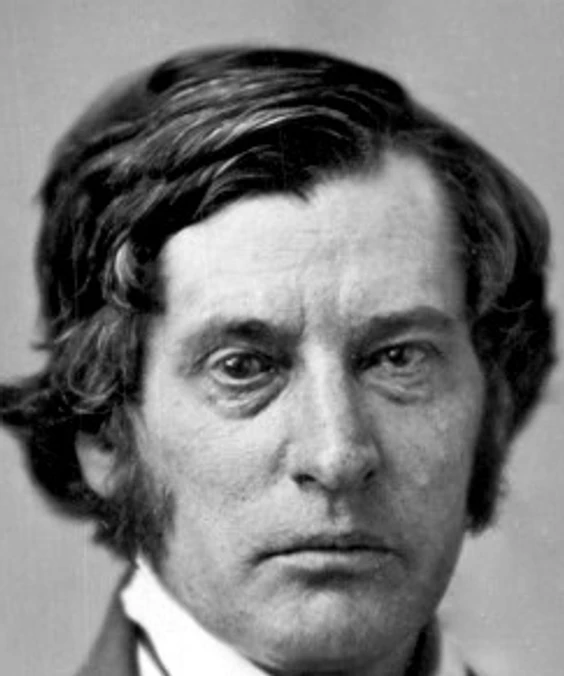
Horace Mann
The Public Record
Horace Mann was an American educational reformer, abolitionist and Whig politician known for his commitment to promoting public education; he is thus also known as The Father of American Education. In 1848, after public service as Secretary of the Massachusetts State Board of Education, Mann was elected to the United States House of Representatives (1848–1853). From September 1852 to his death in 1859, he served as President of Antioch College.
gutenberg.org
And how, under our constitution, can the court know such facts as convert a presumptive freeman into a slave without a trial by jury?
He must be proved to be held, or he remains free; the court must know that he is so held before they are authorized to surrender him.
It is not enough that a man be charged to be held to service.
Now, who can avoid perceiving the difference between the legal force of the words “held” and “charged”?
In regard to slaves, the constitution says,--“No person HELD to service,” &c.; but in regard to criminals, its language is, “A person CHARGED,” &c.
Such want of equity between the parties stamps this law as infamous,--for inequity is iniquity.
That is, the claimant may select, from among an indefinite number of irresponsible magistrates, the one whose ignorance or whose turpitude may promise the best chances of success.
We have seen that a decision of the commissioner adverse to the respondent delivers him over into absolute, unconditional slavery.
And who will be bold enough to say that a trial and judgment by him, delivering up the respondent to bondage, would not be the exercise of “judicial power” in a controversy between “a state and a citizen of another state”?
Now, a free citizen of Massachusetts may enter the port of Charleston as a mariner, be seized, imprisoned, and then sold into slavery for non-payment of jail fees.
It is clear that the judicial department is authorized to exercise jurisdiction to the full extent of the constitution, laws, and treaties of the United States, whenever any question respecting them shall assume such a form that the…
By the first article, all legislative power “shall be vested in a Congress.” By the second article, the “executive power shall be vested in a President.” And by the third article, “the judicial power shall be vested” in the courts.
If, then, this power is a “judicial power,” the constitution peremptorily forbids that it should be vested any where but in a “court,” whose “judges” are nominated, confirmed, sworn, hold office, are paid, and are removable, according to…
In no case known to the common law, or indeed to any other law, is a plaintiff invested with full rights, except after final judgment.
Now, to say that the power which effects these results is not a judicial power, is to do violence to language, and to commit a fraud upon the inherent nature of ideas.
If he chooses to exercise his authority in such a way, he can order his victim to carry him home on his back, and make him bear the loathsome burden of his person as well as of his will.
The plaintiff, thenceforth, may control his actions, his words, his food, his sleep.
From that moment, if the law has any validity, the defendant is the slave of the plaintiff, by force of a “judicial” decision.
The case cannot be reheard or reëxamined by any judge, or by any court, of any state, or of the United States.
The decision of the commissioner is to be final and conclusive, and the subject-matter of the decision is liberty and property.
It results inevitably from the very nature of the power conferred by the law.
The commissioner is never to be paid by the government, but is wholly dependent for his fees upon the claimant whose case he tries.
The “judge” must be paid by the government, and is independent of all the parties before his court.
If Congress could not do this by express enactment, how can it do so by implication?
Politicians like Horace Mann