Even if Congress had declared, by express words, that the commissioners appointed by the circuit and district courts should be taken and held to be “judges,” it would not make them so; for Congress cannot delegate any power to judges to…
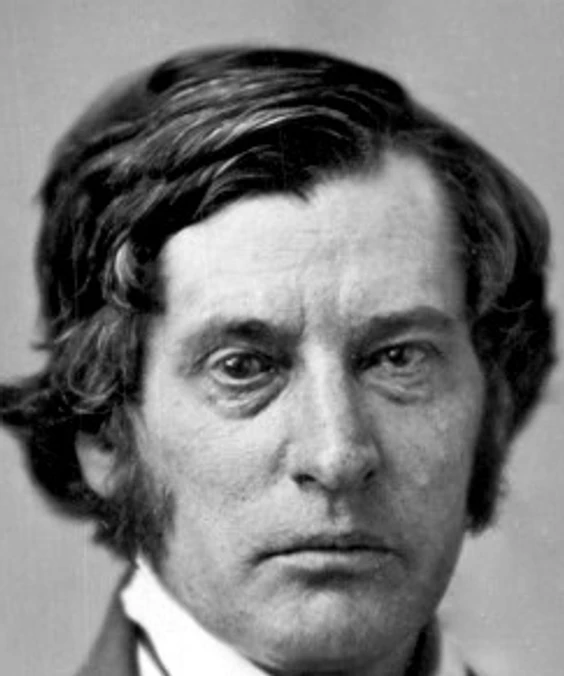
Horace Mann
The Public Record
Horace Mann was an American educational reformer, abolitionist and Whig politician known for his commitment to promoting public education; he is thus also known as The Father of American Education. In 1848, after public service as Secretary of the Massachusetts State Board of Education, Mann was elected to the United States House of Representatives (1848–1853). From September 1852 to his death in 1859, he served as President of Antioch College.
gutenberg.org
Now, my objection is, that the Fugitive Slave law requires the creation of a large body of officers who are not “judges,” but whom it purports to invest with “judicial powers.
The constitution also defines what it means by “judicial power.” It says, “The judicial power shall extend to all cases in law and equity arising under this constitution, the laws of the United States,” &c.
Here we are not left to inference or construction, but can stand on the plain words of the constitution.
Another objection to the Fugitive Slave law is, that it confers judicial power upon persons who are not judges.
Would a wretch, vile enough to rob a man of his liberty, carry him five hundred or a thousand miles, and then go to a shire town during a session of the court, and give his pretended slave a purse of money with which to fee a lawyer for…
Would such be the case of a kidnapped freeman?
All the arguments which I have ever heard, or seen, on this point, gratuitously assume, that the persons reclaimed and transported will have an honest master, be surrounded by kind friends, and have a lawyer at hand whom they can consult…
Nay, he may not be carried to any state in this Union; but may be sent to Cuba or Brazil; beyond hope, and into the outer darkness of despair.
He will be sent to some interior region, perhaps fifty miles from any court, or the residence of any counsel, where he may never have an opportunity to speak to a white man unless it be to a taskmaster, who is paid to guard and to silence…
In Baltimore, or Louisville, a kidnapped freeman might find an opportunity of self-redemption; but such a captive will never be carried to Baltimore or Louisville.
You might as well put out a man’s eyes, and then talk of his right in the common sunlight.
His rights would be lost in his enforced disability to defend them.
Does not every one see that, in ninety-nine cases in a hundred, a control over the defendant’s person and will would be a control over his case?
Yet what need would there ever be of corrupting witnesses or suborning counsel, if a party could get bodily possession and absolute control of his antagonist himself?
To tamper with the witnesses of the adverse party, or endeavor to suborn his counsel to violate their duty to their client, is not only an act of the grossest baseness, but would subject the offender to penal retribution.
Still more grievous would the hardship become, if, under the new jurisdiction, the defendant might be deprived of the evidence which, at home, would be decisive of his rights, or find himself controlled by adverse laws which he never had…
He gets command, not only of the thing in litigation, but of the body and soul of the litigant.
What an atrocity it would be to seize a man in the latter country, and carry him to Holland to be tried and executed for doing an act which, according to the law of the place where he had a right to be tried, may have been not only…
Now, what greater outrage can be inflicted upon a man than to seize, and bind, and carry him into a foreign jurisdiction, where not only is the evidence different, by which his rights may be proved, but where the law also is different, by…
It is not true, then, in any just sense, that the trial by jury is still “preserved” to the alleged fugitive, notwithstanding his removal to a slave state.
This violation, therefore, of the principles of the common law, in regard to the place of trial, is, to him, of the most momentous consequence.
The freeman, then, by being removed as a fugitive into a slave state, may lose his evidence, which, under such circumstances, is the loss of his liberty.
By transferring the trial to the place of the claimant’s domicile, an effective, and, as it seems to me, a most iniquitous advantage is given him, in regard to evidence, while the respondent is subjected to cruel disabilities.
But if a freemen is carried away, a grievous and intolerable wrong is done; a wound is inflicted which mortal medicaments cannot heal, nor the longest continued punishment of the malefactor ever expiate.
Politicians like Horace Mann