Yet this is precisely, and in totidem verbis, what the pro-slavery argument says to the respondent when he is brought before the commissioner and put in peril of his freedom.
Horace Mann
The Public Record
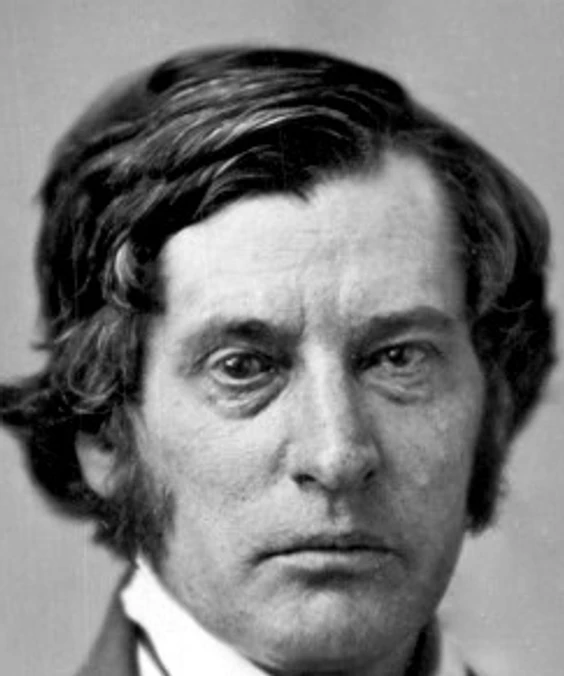
Horace Mann was an American educational reformer, abolitionist and Whig politician known for his commitment to promoting public education; he is thus also known as The Father of American Education. In 1848, after public service as Secretary of the Massachusetts State Board of Education, Mann was elected to the United States House of Representatives (1848–1853). From September 1852 to his death in 1859, he served as President of Antioch College.
gutenberg.org
When they claim the trial by jury, neither plaintiff nor prosecutor can say, You are not entitled to this form of trial, because you are presumptively a debtor, or presumptively an offender.
In the eye of the law, he is as innocent as the unborn child.
So the government must prove the guilt of the man it has arraigned.
And the argument, that if a man be wrongfully consigned to bondage he may be afterwards restored to freedom, is as audacious and as tyrannical as to say that an innocent man may be hanged and sent into another world as a felon, because…
Just so, because human tribunals cannot know with certainty who is a slave and who is free, the constitution gives the trial by jury, before any man in a free state shall be deprived of his freedom.
It is because the law cannot know with infallible certainty, beforehand, who is a murderer, that it provides the trial by jury to determine the question.
I reply, that we possess our right to protection under the constitution and laws, and are not to be turned over to public sentiment or public watchfulness in order to enjoy it.
But under such a law as this, who can tell what may happen to men arrested away from home, to unprotected women, and to helpless children?
I am not now speaking of the special danger to each particular individual, but of the principle that embraces us all.
This is not only anticipating the judgment at the commencement of the proceedings, but it is anticipating the worst judgment that can be passed; and, by anticipating, procuring it; as prophecies often procure their own fulfilment.
How then can he be subjected to a trial which reverses the whole law of presumption in favor of freedom, and which presumes that he is a slave to begin with?
While such, he is entitled to every security which the constitution gives to a free man.
On the contrary, nothing can be more clear, than that the civil condition or status of every man found in a free state is that of a free man.
The iniquity of the law is, that it enables a perjured or fictitious slave owner, on proofs most easily fabricated, to seize any individual in a free state, and to prejudge him to be a slave, by the very form of trial which this law…
If he is prima facie a freeman, then he is entitled to the most perfect mode of trial.
If the person arrested is prejudged to be a slave, then there is no need of a trial at all.
The real question is, who is to be delivered up, a slave or a freeman?
A man who has a presumptive right to his liberty, has a perfect right to all the means to prove it.
Any thing else under the form of justice is a mockery of justice.
Why, then, should the courts of justice be arraigned, if a freeman, instead of a slave, is sometimes consigned to bondage?
Any other interpretation assumes this as a postulate, namely, that there is a higher or surer kind of trial applicable to freemen, and a lower or inferior mode of proceeding applicable to slaves.
No; the liberty to which every man, of whatever color, in a free state, is prima facie entitled, invests him with its protection, and this investiture cannot be stripped from him but by the judgment of his peers or the law of the…
If, then, these rights have no relation to complexion, all white men may be arbitrarily presumed to be slaves, and be deprived of the form of trial, secured to them by the constitution, just as well as any colored man can be.
No axiom is more universal or indisputable, than that the right to freedom in a free state, and the right to be held and treated by the courts as a freeman, has no relation to complexion.
Politicians like Horace Mann