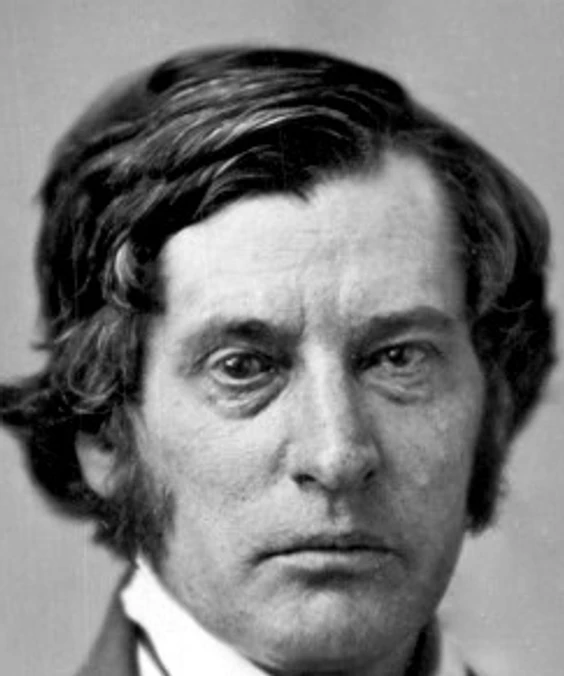
Enslavement and liberty being incompatible, when he suffers the first, though but for an hour, he is deprived of the last.
Horace Mann
The Public Record
Horace Mann was an American educational reformer, abolitionist and Whig politician known for his commitment to promoting public education; he is thus also known as The Father of American Education. In 1848, after public service as Secretary of the Massachusetts State Board of Education, Mann was elected to the United States House of Representatives (1848–1853). From September 1852 to his death in 1859, he served as President of Antioch College.
gutenberg.org
Does any one say that a victim of this law has not been “deprived” of his liberty because he may sue for it, and possibly recover it, in the courts of the state to which he is carried?
And the argument is, that this form of punishment may constitutionally be inflicted, because it was so inconceivably atrocious and diabolical that the constitution did not prohibit it,--because the constitution only prohibited “cruel and…
The constitution has provided that “cruel and unusual punishments shall not be inflicted,” even for the perpetration of the worst of crimes; yet here is a case where the most cruel of punishments, or of privations, may be inflicted without…
Is not perpetual imprisonment of the nature and substance of punishment,--of the severest punishment?
This imprisons him, and makes the man his keeper who is interested to make that imprisonment perpetual in himself, and descendible to his children, and his children’s children forever.
If such a proceeding does not deprive a man of his freedom, by what means can he be deprived of it?
Can a man be adjudged a slave; held, coerced, beaten as a slave; with all his powers and faculties of body and mind subdued and controlled as a slave’s, and yet possess or retain liberty?
The constitution declares, “The right of the people to be secure in their persons,” “against unreasonable” “seizures, shall not be violated; and no warrant shall issue but upon probable cause, supported by oath or affirmation, and…
In the first place, I believe the constitution not only authorizes but requires a trial by jury, in the case of alleged fugitive slaves, when claimed in free states.
Do I expect that the members of that body will be more careful than the senators from Georgia and South Carolina to form their opinions without any regard to selfish considerations?
Can I have confidence in the supreme court of the United States, when my confidence fails in senators around me here?
Even should the supreme court of the United States declare the law to be constitutional, then, though we must acknowledge their decision, as to the point decided, to be the law of the land, until it is set aside, yet, without any…
As for any arrogant or supercilious dictum, either that the law is constitutional or that it is not constitutional, unaccompanied by any reason or any reference, all reflecting men must regard it as sheer insolence, come from what quarter…
My own opinion is, in view of the great principles of civil liberty out of which the constitution grew, and which it was designed to secure, that this law cannot be fairly and legitimately supported on constitutional grounds.
It is a law that might be held constitutional by a bench of slaveholders, while it would be held unconstitutional by all the inhabitants of a free land.
Natural biases operate like a law of gravitation to sway different minds in different directions.
We know, too, that in addition to the powerful influences of education and training, the general cast and structure of men’s minds predispose them to take one side or the other of great political and religious questions.
It presents a case where commentators and expounders must appeal to precedents and analogies, and to general principles respecting the nature of government and the object of all law.
The constitutionality or unconstitutionality of the Fugitive Slave law is not a question to be determined solely by any single and simple provision of the fundamental law.
That reply is, that on a great moral and political, as well as legal question,--a question that connects itself with ethics, as well as with partisan politics, and the success of old parties or the formation of new ones,--integrity is as…
But if we gather the opinions of disinterested and unbiased men; of those who have no money to make or office to hope for through the triumph of the law, then I think the preponderance of opinion is decidedly the other way.
However much a man may reverence the constitution, though he may make it an idol and worship it, yet I mean to show him that this law is an unholy thing in its presence.
It is to make them labor for the right with a zeal commensurate with the infinite baseness of the appeal by which they are urged to abandon it.
What would now be our condition if the prophets and heroes of olden days, if the warriors for truth and the martyrs of liberty, all over the earth, had yielded to so base an argument as this, and had followed the multitude to do evil…
Politicians like Horace Mann