I have examined the matter with some care, and I know of no slave-statute which says that Africans alone shall be slaves.
James Blaine
The Public Record
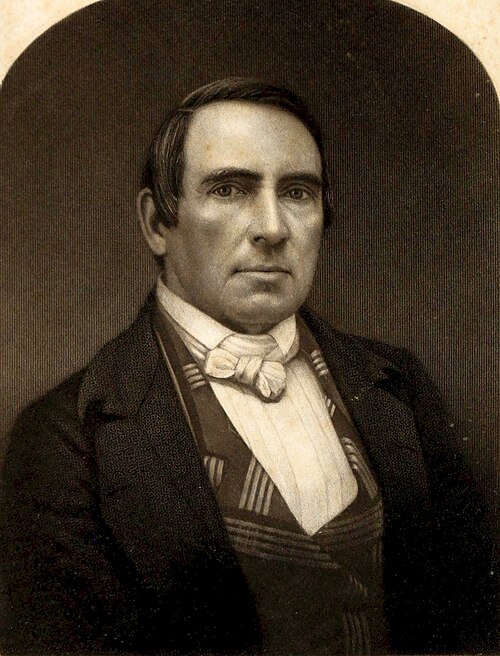
James Gillespie Blaine was an American statesman and Republican politician who represented Maine in the United States House of Representatives from 1863 to 1876, served as Speaker of the House from 1869 to 1875, and was a United States senator from 1876 to 1881. He served twice as Secretary of State, under presidents James A. Garfield and Chester A. Arthur in 1881, and under Benjamin Harrison from 1889 to 1892. He sought the Republican presidential nomination in 1876 and 1880, and received the nomination in 1884, narrowly losing the general election to Democratic nominee Grover Cleveland. Blaine was a prominent figure in the moderate faction of the Republican Party, known as the "Half-Breeds".
gutenberg.org
If we exclude that principle from this amendment we shall be accused of narrow, illiberal, mean-spirited, money-grasping policy.
Blaine objected that "if by ordinary fair play we exclude any class from the basis of representation they should be excluded from the basis of taxation, and therefore we should strike out the word 'taxes.' Ever since the Government was…
The peculiar feature of this amendment was that if any portion of the people should be excluded by reason of race or color, every individual of that race or color would be excluded from the basis of apportionment.
The ratio of voters to population differs very widely in different sections, varying, in the States referred to, from a minimum of nineteen per cent to a maximum of fifty-eight per cent; and some of the changes which its effect would work…
I shall confine my examination of these results to the nineteen free States, whose statistics are presented in the census of 1860, and the very radical change which the new basis of apportionment would produce among those States forms the…
The great mass of Republicans in Congress maintained that it was not only common justice but common sense to define, without interposition or advice from the South, the conditions upon which the insurrectionary States should be re-clothed…
The magnitude of the reforms for which the popular desire was unmistakable, may in some degree be measured by the fact that they involved the necessity of radical changes in, and important additions to, the Federal Constitution.
If that were not accomplished, the burden would be so great that the Nation which had survived the shock of arms might be engulfed in the manifold calamities of bankruptcy.
So long as the Government was compelled to pay its interest in coin, while the business of the country was conducted upon the basis of suspended paper, the burden upon the people would be great.
The acknowledged and imperative indebtedness of the Government was already enormous; contingencies yet to be encountered would undoubtedly increase it, and its weight would press heavily upon the people until a firmly re-established credit…
Perhaps it would be more truthful to say that the ambitions and conspiring politicians of the South had assumed the danger to this vast investment as the pretext for destroying the Government; and they had met with the fate so solemnly…
The money value of Southern slaves, reckoned at current prices, was larger when the war broke out than the money value of railroads or of manufacturing establishments in the United States.
With the single exception of land, which is the basis of all property, the South had lost the largest aggregate investment held in one form in the entire country.
From the crime of rebellion they had been freed by the President, but it was expected that Congress would clearly define the difference between pardoning a rebel for treason to his county and endowing him with the right to enjoy the honors…
If there should be no provision to the contrary, these pardoned men would thus become as eligible to all the honors and emoluments of the Republic as though they had not for four years been using their utmost efforts to destroy its…
To allow this to be accomplished would be a mere mockery of justice, the utter subversion of fair play between man and man.
By permitting this, a Confederate soldier who fought to destroy the Union would be endowed with a larger power of control in the National Government than the loyal soldier who fought to maintain the Union.
There was an obvious injustice in giving to the white men of the South the right to elect representatives in Congress apportioned to their section by reason of the four and a half million of negroes, who were enumerated in the census but…
If he should remain in office he feared it might be at the expense of forfeiting the good will of the tens of thousands of New-York Republicans who had always reposed the utmost confidence in his fidelity to principle, and who had rewarded…
He was essentially a radical man in all his political views, and the evident tendency of the President towards extreme conservatism on the question of reconstruction was a keen distress to him.
It was well said at the time that the framers of the Constitution in 1787 were not confronted with difficulties so grave or surrounded with problems so complex and unproved, as were the leaders of Congress during the period of…
In reviewing the events of that day, whatever may be thought respecting their wisdom and expediency, candid men of all parties will concede that the Republican leaders exhibited great determination of purpose, remarkable steadiness of…
When public interest is heightened the imagination of the people is stimulated, until trifles light as air have fatal significance in one direction or the other.
It was the first attempt in our history to establish the policy of the Government without regard to the President, and indeed against his power.
Politicians like James Blaine