It was undoubtedly a very sweeping enactment, the operation of which was not confined to the States which had been slave-holding, but bore directly upon some of the free States where the negro had always been deprived of certain rights…
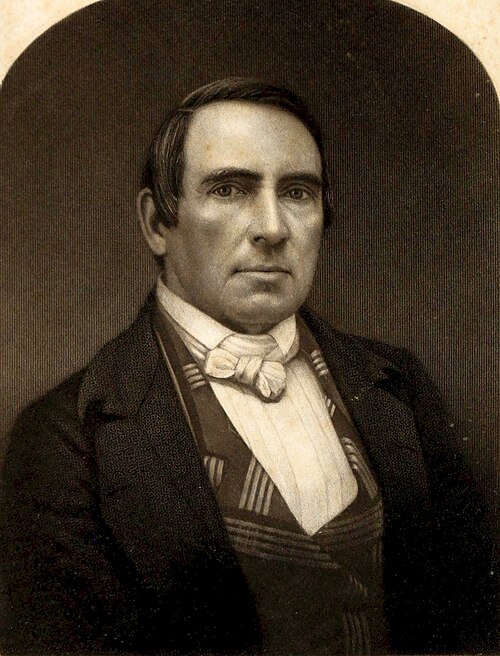
James Blaine
The Public Record
James Gillespie Blaine was an American statesman and Republican politician who represented Maine in the United States House of Representatives from 1863 to 1876, served as Speaker of the House from 1869 to 1875, and was a United States senator from 1876 to 1881. He served twice as Secretary of State, under presidents James A. Garfield and Chester A. Arthur in 1881, and under Benjamin Harrison from 1889 to 1892. He sought the Republican presidential nomination in 1876 and 1880, and received the nomination in 1884, narrowly losing the general election to Democratic nominee Grover Cleveland. Blaine was a prominent figure in the moderate faction of the Republican Party, known as the "Half-Breeds".
gutenberg.org
It is a condition not implying dishonesty or even recklessness, but one which follows from a positive inability in the public mind to estimate the expenditure of money by the standards which are applied in the era of peaceful industry…
The great expansion of our currency, the ease with which money had been obtained, and the extravagance with which it had been expended in all the walks of life, produced in the minds of the people an indifference to the question of economy.
The philanthropists did not deem the question at issue to be one of dollars and cents; and those less disposed to sympathize with the humanitarian aspects of the subject had not yet learned the lesson of economy which the adversity of…
In my judgment most of these States, so far at least as depends upon their own acts, have already been fully restored and should be deemed as entitled to enjoy their Constitutional rights as members of the Union.
The State of Tennessee, for instance, whose authorities were engaged in rebellion, was restored to all her Constitutional relations to the Union by the patriotism and energy of her patriot people.
I assert that it is such as would bring disgrace upon any despotism in Christendom.
Suffrage without education is an edged tool in the hands of a child,--dangerous to others and destructive to himself.
Who can doubt that if a man is to govern himself he should have the means to know what is best for himself, and what is injurious to himself, what agencies work against him and what for him?
The public opinion of the country unmistakably sustained this legislation--the purpose to extend protection to the freedmen being deep-set and all-pervading among the men of the North who had triumphed in the war.
The war would thus have practically injured the negro, for after taking from him that form of protection which slavery afforded, it would have left him an object of still harsher oppression than slavery itself--an oppression that would be…
It was designed for the purpose of extending to the freeman protection against all the wrongs of local legislation, and to make him feel that the Government which had freed him would not desert him and allow his release from slavery to be…
Trumbull's bill conferring upon the Freedmen's Bureau a degree of power which combated and restrained the Southern authorities at every point where wrong was committed or menaced.
Thus not only was rank injustice contemplated by the States lately in rebellion, but they conveyed also an insulting challenge to the authority of the Nation.
The Southern States had responded to this Act of National authority by enacting a series of laws which really introduced, as has already been shown, a new, offensive and most oppressive form of servitude.
The Thirteenth Amendment, about to be formally promulgated by the Executive Department of the Government, as incorporated in the Constitution, had made every negro a free man.
Temporary relief however was afforded; but much harm was done by creating in the minds of ignorant freedmen, just redeemed from slavery, the belief that the Government would give to each of them "forty acres of land and a mule.
The white population of the South were themselves reduced almost to poverty by the long struggle; and even if they had been able they were in no mood to extend relief to negroes who, as they believed, had been wrongfully released from…
Having taken the responsibility of freeing them, first by Proclamation of the President and then by Amendment of the Constitution, it would have been a lasting reproach to the Government not to extend protection and assistance to such of…
But for the interposition of the National Government there was serious danger that thousands of them might be reduced to starvation.
The change of view was important and led to far-reaching consequences.
Another theory and another practice were now to prevail; for it had been demonstrated to the thoughtful statesmen who then controlled the Government, that every thing which may be done by either Nation or State may be better and more…
These divergent practices had been allowed to develop for seventy-seven years of the nation's life, when, admonished by the Stockton case of the latitudinary results to which loose methods might lead, Congress took jurisdiction of the…
The reluctance to interfere with the supposed or asserted rights of States had too long delayed the needful exercise of National power.
Though it may not be perfect in all its details that law has done much to insure the fair and regular choice of senators.
Politicians like James Blaine