It may not be said that all hope of reconciliation was abandoned, but friendly co-operation to any common end became extremely difficult.
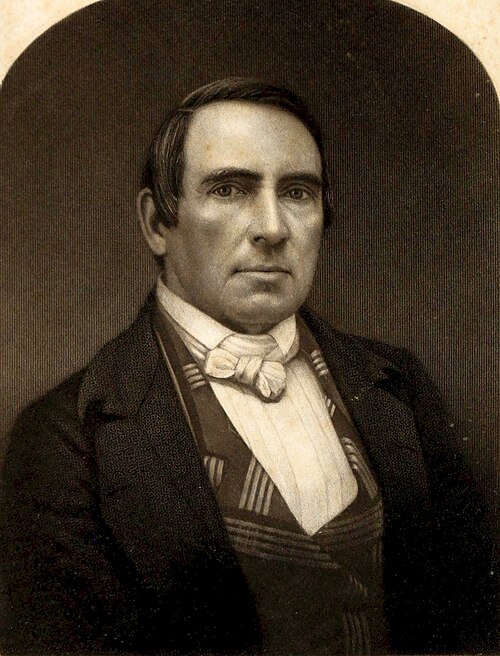
James Blaine
The Public Record
James Gillespie Blaine was an American statesman and Republican politician who represented Maine in the United States House of Representatives from 1863 to 1876, served as Speaker of the House from 1869 to 1875, and was a United States senator from 1876 to 1881. He served twice as Secretary of State, under presidents James A. Garfield and Chester A. Arthur in 1881, and under Benjamin Harrison from 1889 to 1892. He sought the Republican presidential nomination in 1876 and 1880, and received the nomination in 1884, narrowly losing the general election to Democratic nominee Grover Cleveland. Blaine was a prominent figure in the moderate faction of the Republican Party, known as the "Half-Breeds".
gutenberg.org
A House, four-fifths of whose members were Republicans, had refused to pass a resolution expressing confidence in the President who, fourteen months before, had received the vote of every Republican in the Nation.
I allude to them to condense their monstrous enormities of guilt into one crime, and to point the gentleman from New York to it and tell him that that was the specific act.
I allude to them to remind us how utter was the overthrow and the obliteration of all government, divine and human, how total was the wreck of all constitutions and laws, political, civil and international.
And then to give to the infernal drama a fitting close, and to concentrate into one crime all that is criminal in crime and all that is detestable in barbarism, they murdered the President of the United States.
They destroyed, in the four years of horrid war, another army so large that it would reach almost around the globe in marching-column.
They murdered, by systems of starvation and exposure, sixty thousand of your sons as brave and heroic as ever martyrs were.
They planned one universal bonfire of the North, from Lake Ontario to the Missouri.
They poisoned your fountains, put mines under your soldiers' prisons, organized bands whose leaders were concealed in your homes, and whose commissions ordered the torch to be carried to your cities, and the yellow-fever to your wives and…
They carved the bones of your unburied heroes into ornaments and drank from goblets made out of their skulls.
Their pirates burned your unarmed commerce upon every sea.
For years they besieged your Capital and sent your bleeding armies in rout back here upon the very sanctuaries of your national power.
They framed iniquity and universal murder into law.
They passed sequestration and other Acts in flagitious violation of the law of nations, making every citizen of the United States an alien enemy, and placing in the treasury of their rebellion all money and property due such citizens.
They expelled from their land or assassinated every inhabitant of known loyalty.
Their senators and representatives in your Congress insulted, bantered, defied and then left you.
They seized, in their States, all the Nation's property.
They discarded all their official oaths, and took, in their places, oaths to support your enemies' government.
They obliterated from their State constitutions and laws every vestige of recognition of your Government.
In it they threw off and defied the authority of your Constitution, your laws, and your Government.
It was absolutely without acrimony, it contained no harsh word, it made no personal reflection; but the whole duty of the United States, and the whole power of the United States to do its duty, were set forth with absolute precision of…
If I find it does continue to be a State after that, then I shall strive to ascertain whether it will so continue to be a Government--a State--after, by means of universal treason, it has ceased to have any constitution, laws…
I shall discuss the question whether an organized rebellion against a government is an organized State in that government; whether that which cannot become a State until all its officers have sworn to support the Constitution, remains a…
Stevens, if carried to its legitimate consequences, would make those who resisted the Confederacy in the insurrectionary states guilty of treason to that power; and that therefore "we would be unable to talk of loyal men in the South.
I think we all agree that an ordinance of secession passed by any State of the Union is simply a nullity because it encounters the Constitution of the United States which is the supreme law of the land.
Politicians like James Blaine