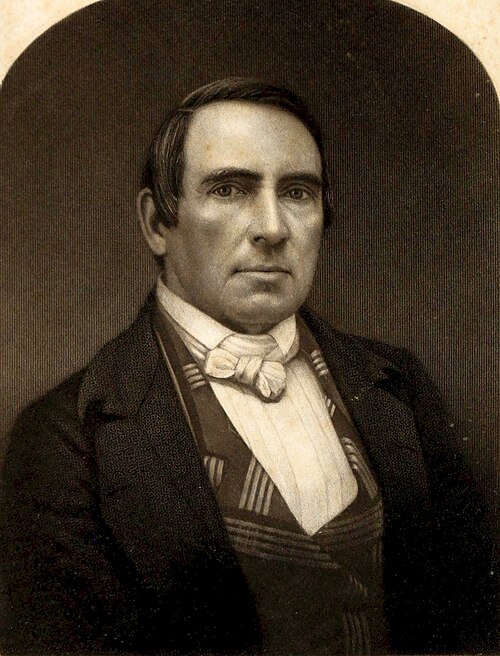
By what specific act, at what precise time, did any one of those States take itself out of the American Union?
James Blaine
The Public Record
James Gillespie Blaine was an American statesman and Republican politician who represented Maine in the United States House of Representatives from 1863 to 1876, served as Speaker of the House from 1869 to 1875, and was a United States senator from 1876 to 1881. He served twice as Secretary of State, under presidents James A. Garfield and Chester A. Arthur in 1881, and under Benjamin Harrison from 1889 to 1892. He sought the Republican presidential nomination in 1876 and 1880, and received the nomination in 1884, narrowly losing the general election to Democratic nominee Grover Cleveland. Blaine was a prominent figure in the moderate faction of the Republican Party, known as the "Half-Breeds".
gutenberg.org
If I believed in the premises he assumes, possibly though I do not think probably, I might agree with the conclusion he has reached; but, sir, I cannot believe that these States have ever been out of the Union or that they are now out of…
If we fail in this great duty now when we have the power, we shall deserve to receive the execration of history and of all future ages.
If we do not hedge them around with protecting laws, if we leave them to the legislation of their old masters, we had better have left them in bondage.
This Congress is bound to look after them until they can take care of themselves.
The diabolical laws of slavery have prevented them from acquiring an education, understanding the commonest laws of contract, or of managing the ordinary business of life.
Not the Judiciary, not the President; but the sovereign power of the people, exercised through their representatives in congress, with the concurrence of the Executive.
Unless the law of Nations is a dead letter, the late war between the two acknowledged belligerents severed their original contracts and broke all the ties that bound them together.
They are diligently contrived for catches and committals to be subsequently used in political campaigns, but it may well be doubted whether they ever produce substantial effect upon legislation or prove either gainful or hurtful in…
The contest, predestined and already manifest, between the President and Congress might, unless conducted with great wisdom, so seriously divide the party as to compass its ruin.
Its truth was now signally vindicated, when, against the authority of those in high places, against the instruction of those who had always before been trusted, the mass of the Republican party stood with heroic firmness for what they…
The ancient maxim, that the voice of the people is the voice of God, is illogical in its direct statement, and like all adages it covers both a truth and an untruth.
The quick comprehension of the people so far transcends that of a single person as to amount almost to the possession of a sixth sense.
The great mass of loyal Republicans had descried a peculiar danger in the gentle, persuasive, insinuating words with which the President, in his annual message, sought to commend his policy.
Though a man of the strictest personal integrity, he had apparently no scruples on this subject, but believed that the patronage of the Government might be honestly used to build up his own political power.
The patronage placed a formidable weapon in the hands of the President which could be so used as to annoy or help every Republican representative in Congress,--so used, indeed, as to prevent the election of many who were peculiarly…
Public opinion, which has in later years tended to restrain the Executive Department from the personal use of the patronage of the Government, did not at that time exert a perceptible influence in this direction.
In proportion to the population of the country there never had been, there has never since been, and perhaps there will never again be, so vast an official patronage placed at the absolute disposal of the President.
Without early advantages, either of education or fortune, he was in the best sense of the phrase a self-made man.
He was a lawyer in full practice, a man of the highest integrity, without fear and without reproach.
His argument was the one skillfully employed by all who seek an adjustment between those who ought to be friends: Let each party give way a little; let a common ground of action be established; and, above all, let the calamity of a party…
The sum of the whole, or the central fact of the whole series, was that the color of the skin must not exclude a loyal man from civil rights.
Sumner submitted resolutions defining the duty of Congress in respect to guarantees of the National security and National faith in the rebel States.
The presence of these obnoxious persons inflamed minds not commonly given to excitement, and drove many men to act from anger who were usually governed by reason.
The President's reconstruction policy would have been much stronger if the Southern elections to Congress had been postponed, or if the members elect had remained at home during the discussion concerning their eligibility.
Politicians like James Blaine