In the decision itself, however, there has been general acquiescence, and it led to an important reform in the manner of choosing United-States senators.
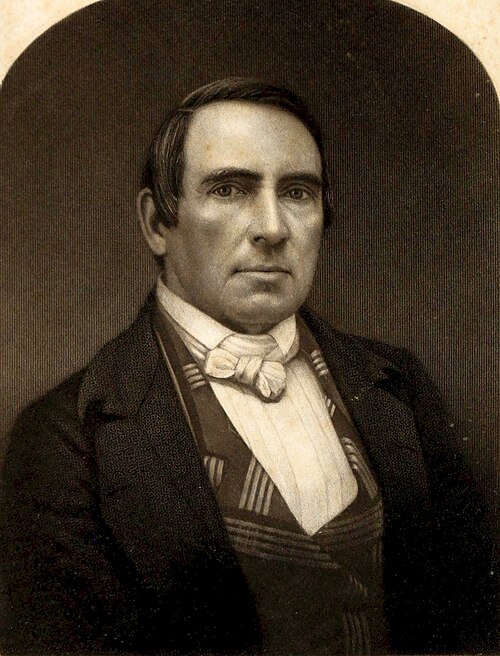
James Blaine
The Public Record
James Gillespie Blaine was an American statesman and Republican politician who represented Maine in the United States House of Representatives from 1863 to 1876, served as Speaker of the House from 1869 to 1875, and was a United States senator from 1876 to 1881. He served twice as Secretary of State, under presidents James A. Garfield and Chester A. Arthur in 1881, and under Benjamin Harrison from 1889 to 1892. He sought the Republican presidential nomination in 1876 and 1880, and received the nomination in 1884, narrowly losing the general election to Democratic nominee Grover Cleveland. Blaine was a prominent figure in the moderate faction of the Republican Party, known as the "Half-Breeds".
gutenberg.org
In a matter so directly affecting the interests and the feelings of the people of New Jersey it was certainly a hardship that the voice of the State was not heard.
The haste with which the question was brought to a decision can hardly be justified, and is a striking illustration of the intense party-feeling which had been engendered by the war.
Was it not this, and this only?--that when it authorized a body other than itself, though constituted of the same members, a convention to choose a senator, that body must proceed in the choice of a senator according to the universally…
Their constancy was greater than that of the Whigs because the rights of person transcend the rights of property.
The Republicans of 1866 were contending for a vastly greater stake,--for the sacredness of human rights, for the secure foundation of free government.
No unmanly efforts to compromise, no weak shirking from duty, sullied the fame of the great body of senators and representatives.
It is to the eminent credit of the Republican members of Congress that they stood in a crisis of this magnitude true to principle, firm against all the power and all the patronage of the Administration.
If you are not ready to be the Moses of an oppressed people, do not become their Pharaoh.
An avenging God cannot sleep while such things find countenance.
The power that gives freedom must see that freedom is maintained.
The performance of that pledge cannot be intrusted to another, least of all to the old slave-masters, embittered against their slaves.
It is as extended and as immortal as the Republic itself, to that pledge we are solemnly bound; wherever our flag floats, as long as time endures, we must see that it is sacredly observed.
In my judgment our sole authority for the acts which we have done during the last four years was the authority communicated to Congress by the Constitution to suppress insurrection.
I believe that if it should pass it will receive the sanction of nineteen-twentieths of the loyal people of the country.
I offer this bill as a measure of humanity, as a measure that the needs of that section of the country imperatively demand at our hands.
I do not ask their property or their blood; I do not wish to disgrace or degrade them; but I do wish that they shall not be permitted to disgrace, degrade or oppress anybody else.
The Republicans were resolved that their action should neither be misinterpreted by opposing partisans nor misunderstood by the people.
Their efforts now to clothe the Southern conspirators with fresh power and to take no note of the crimes which had for four years drenched the land in blood, constituted an offense only less grave in the eyes of the Republicans than the…
Their policy, in short, seemed to have the interests of the guilty authors of the Rebellion more at heart than the safety of the Union.
Like most sweeping affirmations this has its exceptions, but the list of young men who have been advanced to prominent positions in the body is so large that it may well be assumed as the rule of promotion.
It has long been a tradition of the House that no man becomes its leader who does not enter it before he is forty.
He had placed himself in a position from which he could not with grace retreat, and to go forward in which was still further to blight his hopes of promotion in his party.
His talents were acknowledged; his courteous manners, his wide intelligence, his generous hospitality, gave him a large popularity; but his alliance with President Johnson was fatal to his political fortunes.
Shellabarger had destroyed his argument, and had given a rallying-point for the Republicans, so incontestably strong as to hold the entire party in allegiance to principle rather than in allegiance to the Administration.
Politicians like James Blaine