The presence in Washington of a considerable number of men from the South, who, when Congress adjourned in the preceding March, were serving in the Confederate Army, and were now at the Capital demanding seats in the Senate and House…
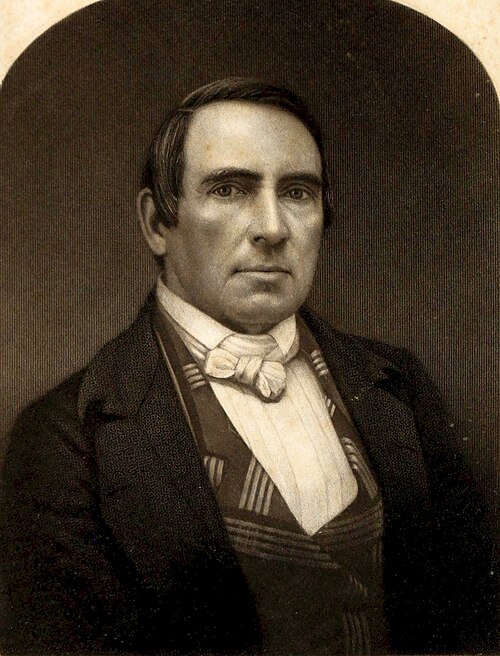
James Blaine
The Public Record
James Gillespie Blaine was an American statesman and Republican politician who represented Maine in the United States House of Representatives from 1863 to 1876, served as Speaker of the House from 1869 to 1875, and was a United States senator from 1876 to 1881. He served twice as Secretary of State, under presidents James A. Garfield and Chester A. Arthur in 1881, and under Benjamin Harrison from 1889 to 1892. He sought the Republican presidential nomination in 1876 and 1880, and received the nomination in 1884, narrowly losing the general election to Democratic nominee Grover Cleveland. Blaine was a prominent figure in the moderate faction of the Republican Party, known as the "Half-Breeds".
gutenberg.org
Its first and highest obligation is to guarantee to every State a republican form of government, to establish the rebellious States anew on such a basis of enduring justice as will guarantee all safeguards to the people and protection to…
The pro-slavery men of the South, in following this course, presented a striking contrast to the anti-slavery men of the North who, under all circumstances and against all temptation, were faithful to the leaders who proved faithful to…
To desert the colored man, and leave him to his fate, undefended, and defenseless against the wrongs already perpetrated and the greater wrongs foreshadowed, would do dishonor to the entire spirit of Mr.
The slavery against which he had warred so long and so faithfully had been abolished in vain if another form of servitude, even more degrading in some of its aspects, was to take its place.
Seward had himself taught the nation that conflict on questions involving the rights of human nature is irrepressible.
But this necessity can never apply to that class of political questions closely and inseparably allied with moral obligation.
Crises often arise in the conduct of National affairs when cherished opinions must be sacrificed and new departures taken.
His philanthropic nature, the record of his public life, his great achievements in the anti-slavery field, all forbid the conclusion that he could knowingly and willingly consent to the maltreatment and the permanent degradation of the…
The Southern men believed and boasted that they would subject to general reproach and expose to open shame that whole class of intermeddlers and fanatics (as they termed opponents of slavery) who had destroyed so many lives and wasted so…
Even the paltry pretext, afterwards so often advanced, that they were irritated and maddened by the interposition of carpet-bag power, does not avail in the least degree for the outrages in the era under consideration.
The South had no excuse for its course, and the leaders of its public opinion at that time will always, and justly, be held to a strict accountability.
When the Congress of the United States, acting independently of the Executive power of the Nation, decreed emancipation by amending the Constitution, it solemnly pledged itself, with all its power, to give protection to the emancipated at…
The whole scheme was a ghastly wrong, one which, if attempted upon that class of any population in the North which is able to pay only a poll-tax, would consign the party attempting it to defeat and disgrace, and, if its enforcement were…
Every teacher who was to teach in these schools was required to pay five dollars for his certificate, which also went into the school-fund; and the end of the whole matter was, that a bare pittance was left for the thirty thousand negro…
Indeed, in those States there was scarcely an attempt made to provide for the education of the freedmen, and the suggestions made in that direction carried with them another display of studied wrong.
It might be supposed that ordinary generosity would have devoted it to the education of the ignorant class from which it was forcibly wrung, but no provision of the kind was even suggested.
It was thus ordained that the negroes, who had no property at all, should pay one-third as much as the white men, who had two hundred and fifty millions of property in possession.
Just emerging from a condition of slavery in which their labor had been constantly exacted without fee or reward of any kind, it was impossible that they could be the owners of any thing except their own bodies.
The wrongs inflicted under the name of law, thus far recited, were still further aggravated in a majority of the rebellious States by the exaction of taxes from the colored man to an amount altogether disproportionate to their property.
It was declaring the negro to be free by one statute, and immediately proceeding to re-enslave him by another.
It was altogether a shameless proclamation of indecent wrong on the part of the Legislature of Mississippi.
Justice was defied, and injustice incorporated as the very spirit of the laws.
It was, however, bad enough to stir the indignation of every lover of justice.
Every avenue for improvement was closed against him; and in a State which boasted somewhat indelicately of its chivalric dignity, the negro was mercilessly excluded from all chances to better his condition individually, or to improve the…
Politicians like James Blaine