As soon as the Southern Legislatures assembled, it was made evident that their members disregarded, and even derided, the opinion of those who had conquered the Rebellion and held control of the Congress of the United States.
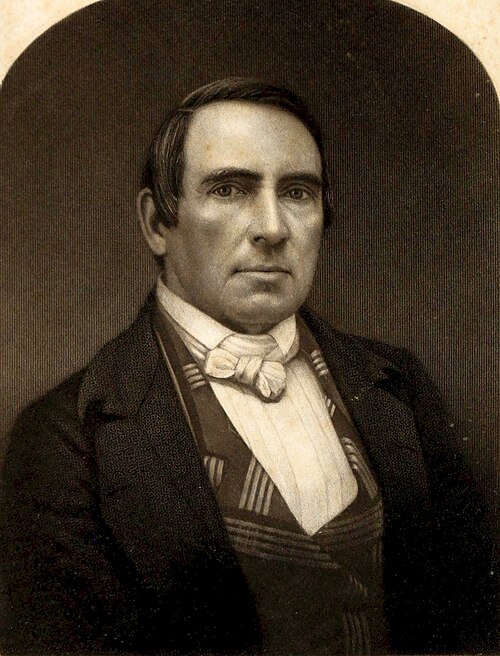
James Blaine
The Public Record
James Gillespie Blaine was an American statesman and Republican politician who represented Maine in the United States House of Representatives from 1863 to 1876, served as Speaker of the House from 1869 to 1875, and was a United States senator from 1876 to 1881. He served twice as Secretary of State, under presidents James A. Garfield and Chester A. Arthur in 1881, and under Benjamin Harrison from 1889 to 1892. He sought the Republican presidential nomination in 1876 and 1880, and received the nomination in 1884, narrowly losing the general election to Democratic nominee Grover Cleveland. Blaine was a prominent figure in the moderate faction of the Republican Party, known as the "Half-Breeds".
gutenberg.org
If in such an organization a spirit of moderation and justice should be shown, if consideration should be exhibited for the negro, even so far as to assure to him the inherent rights of human nature, a deep impression would be made on the…
It was in their power to repair, in large degree, the blunders of policy--nay, the crimes against human rights--which the Reconstruction Conventions had abetted if not committed.
The list of requirements might be enlarged, but the three which are given represent primary and indisputable necessities, without the concession and free establishment of which the negro, with nominal freedom, would be in a worse condition…
In the third place, it was imperatively demanded that some provision be made for the rudimentary instruction of colored children, in order that they might learn the mechanical arts and have the privilege of working at such callings as were…
It was, in the second place, in the highest degree necessary that he should have the benefit of such laws as would assure to him the wages of his labor and confer upon him the right to acquire and hold real estate and other property, with…
But without raising the question of suffrage, there were rights with which the negro must be endowed before he could essentially better his material condition or advance in knowledge.
That privilege was indeed, still denied him in a majority of the loyal States, and it seemed illogical and unwarrantable to expect a more advanced philanthropy, a higher sense of justice, from the South than had been yet attained by the…
Equality, they believed, could neither be conferred nor maintained unless the negro were invested with the badge of American manhood--the right to vote--a right which they were determined to guarantee as firmly to the colored man as it was…
The truth was that the Republicans of the North, constituting, as was shown by the elections of 1865, a majority in every State, were deeply concerned as to the fate and fortune of the colored population of the South.
It might be difficult to determine which displayed the greater folly--those who made false representations, or those who, warned by previous deception, appeared so ready to be influenced anew by deception equally gross.
Many Northern Democrats had indeed given the assurance that if any attempt at coercion should be made by the Republican National Administration, they would themselves meet it with force, and that, if war should come, it would be in the…
Emboldened by the support of the National Administration, the Southern leaders believed that they could carry their designs through, and, instead of being restrained by the protest or the advice of Republicans, they chose with apparent…
The deep-seated prejudice against color is assiduously cultivated by the public journals and leads to acts of cruelty, oppression, and murder, which the local authorities are at no pains to prevent or punish.
The feeling in many portions of the country toward the emancipated slaves, especially among the ignorant and uneducated, is one of vindictive and malicious hatred.
The same individual is elected to an important office in the leading city of his State, although an unpardoned rebel, and so offensive that the President refused to allow him to enter upon his official duties.
The National banner is openly insulted and the National airs scoffed at, not only by an ignorant populace, but at public meetings, and once, among other notorious instances, at a dinner given in honor of a notorious rebel, who had violated…
Not only were the official acts of the Southern Conventions inspired by a spirit of apparently irreconcilable hatred of the Union, but the popular manifestations in the South were for more decided in the same direction.
Stephens secured an election to the Senate, and was in Washington at the ensuing session of Congress, asking admission to a seat as cooly as if every living man had forgotten that for four years he had been exerting his utmost effort to…
They could begin anew with organic laws adapted to the great revolution which had swept over them, or they could patch up the old constitutions now become indissolubly associated with a rebellion which had been fostered and protected under…
But they realized at the same time that the most important demands of far-seeing statesmanship and of true patriotism might be disregarded, and even contemned, by a wild, unreasoning wish of the people to see the old Government, in all its…
Observing men in the loyal States regarded such a policy not only as weak and maudlin, but as utterly insufficient and assuredly dangerous to the future safety of the Government.
If the Southern States should meet the overture of the Administration in the spirit in which it was made, the probability was decidedly in favor of their restoration to their old places without condition, without promise, without sacrifice.
The policy of the President was therefore essentially aided by the patriotic and ardent love for the Union,--a love always present with the loyal people of the free States, but developed in an extraordinary degree by the costly struggle…
The great mass of those who had resisted the National authority were restored to all their rights of citizenship by the simple taking of an oath of future loyalty, and those excepted from immediate re-instatement were promised full…
Politicians like James Blaine