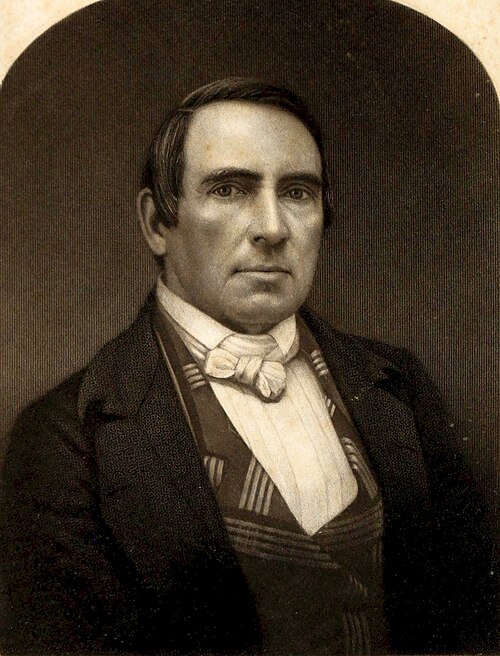
No man had suffered more of personal obloquy from the South than he, no one living had received deeper personal injury from the demoniac spirit, the wicked inspiration of the rebellion.
James Blaine
The Public Record
James Gillespie Blaine was an American statesman and Republican politician who represented Maine in the United States House of Representatives from 1863 to 1876, served as Speaker of the House from 1869 to 1875, and was a United States senator from 1876 to 1881. He served twice as Secretary of State, under presidents James A. Garfield and Chester A. Arthur in 1881, and under Benjamin Harrison from 1889 to 1892. He sought the Republican presidential nomination in 1876 and 1880, and received the nomination in 1884, narrowly losing the general election to Democratic nominee Grover Cleveland. Blaine was a prominent figure in the moderate faction of the Republican Party, known as the "Half-Breeds".
gutenberg.org
In the creed of his own statesmanship, there was no article that comprehended revenge as a just motive for action.
His moral strength, his mental fibre, his wiry constitution were all tested to their utmost, and no doubt to the serious shortening of his days.
The need of action and of energy so pressed upon him that he found no time to utter lamentation, none to indulge even in the most sacred personal grief.
With slavery abolished, the tendency of his mind was towards a lenient policy in Southern matters and for the promptest mode of reconstruction.
He thought rather that works meet for repentance should be shown by these offenders against the law both of God and man, that they should be held to account in some form for the peril with which they had menaced the Nation, and for the…
He certainly came to the public service with patriotic and not with sordid motives, surrendering a most brilliant position at the bar, and with it the emolument of which in the absence of accumulated wealth his family was in daily need.
The policy which he desired to see adopted was that which should restore the Rebel States to their old relations with the Union upon the freest possible conditions and within the shortest possible time.
He believed that unwise discussion of the slavery question had brought our troubles upon us, and that it would be inexcusable to continue an agitation which portended trouble in another form.
But an extra session, especially at the beginning of an Administration, is looked upon with almost superstitious aversion, and is always to be avoided if possible.
Indeed, to the Executive Department of the Government, Congress, even in its regular sessions, is a guest whose coming is not welcomed with half the heartiness with which its departure is speeded.
An extra session of Congress seemed specially desirable at the time, and had one been summoned by the President, many of the troubles which subsequently resulted might have been averted.
The two schools in short marked the dividing line between the radical and the conservative.
The essential difference between the upholders and the opponents of this theory was not shown in the practical treatment proposed for the States which had been in rebellion.
We all agree that the seceded States, so called, are out of their proper practical relation with the Union, and that the sole object of the Government is to get them back into their proper practical relation.
Thank God, Tennessee has never been out of the Union!
It is the doctrine of the Federal Constitution that no State can go out of this Union.
She has bent the tyrant's rod, she has broken the yoke of slavery, she stands to-day redeemed.
I desire to proclaim that Tennessee, whose representative I have been, is free.
On all questions of expediency the President maintained not only the right but the frequent necessity of change.
Concede that the new government of Louisiana is only to what it should be as the egg is to the fowl, we shall sooner have the fowl by hatching the egg than by smashing it.
He will yet attain it sooner by saving the already advanced steps towards it than by running backward over them.
The colored man too, in seeing all united for him, is inspired with vigilance and with energy and daring to the same end.
We encourage the hearts and nerve the arms of twelve thousand men to adhere to their work and argue for it, and proselyte for it, and fight for it, and grow it, and ripen it to a complete success.
We will neither help you nor be helped by you.
Politicians like James Blaine