We say to the white man, you are worthless or worse.
James Blaine
The Public Record
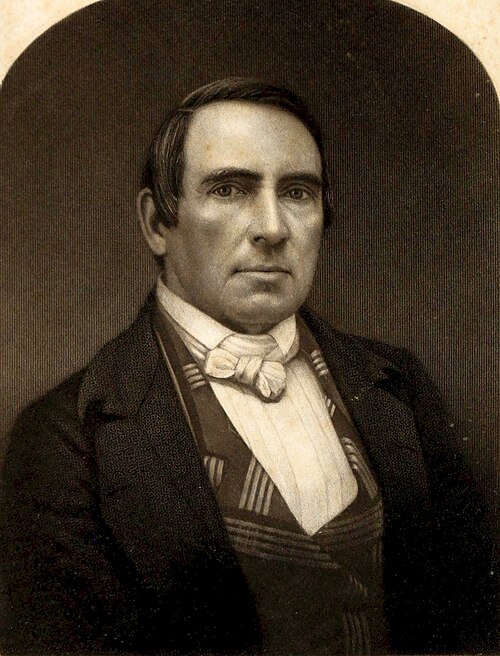
James Gillespie Blaine was an American statesman and Republican politician who represented Maine in the United States House of Representatives from 1863 to 1876, served as Speaker of the House from 1869 to 1875, and was a United States senator from 1876 to 1881. He served twice as Secretary of State, under presidents James A. Garfield and Chester A. Arthur in 1881, and under Benjamin Harrison from 1889 to 1892. He sought the Republican presidential nomination in 1876 and 1880, and received the nomination in 1884, narrowly losing the general election to Democratic nominee Grover Cleveland. Blaine was a prominent figure in the moderate faction of the Republican Party, known as the "Half-Breeds".
gutenberg.org
You are really guilty of weakening your own prerogatives under the Constitution by asking me to assent to their existence.
If I should sign your resolution without explanation, it might imply my right to veto it, and thereby take from you your undoubted Constitutional power.
He had given careful study to the duties, the responsibilities, and the limitations of the respective departments of the Government, and he was not willing that his judgment should be revised or his course censured, however indirectly, by…
Though the least pretentious of men, he had an abounding self-respect and a full appreciation of the dignity and power of his office.
Third, No debt, State or Confederate, created in aid of the rebellion shall ever be paid.
Second, Involuntary servitude shall be forever prohibited, and the freedom of all persons in the State guaranteed.
I barely suggest for your private consideration whether some of the colored people may not be let in, as for instance the very intelligent and especially those who have fought gallantly in our ranks.
There must be a test by which to separate the opposing elements so as to build only from the sound, and that test is a sufficiently liberal one which accepts as sound whoever will make a sworn recantation of his former unsoundness.
An attempt to guarantee and protect a revived State government constructed in whole or in preponderating part from the very element against whose hostility and violence it is to be protected is simply absurd.
I am in no boastful mood: I shall not do more than I can, but I shall do all I can to save the Government, which is my sworn duty as well as my personal inclination.
Would you give up the contest leaving every available means unapplied?
Would you deal lighter blows rather than heavier ones?
Would you drop the war where it is, or would you prosecute it in the future with elder-stalk squirts charged with rose-water?
Of course the Rebellion will never be suppressed in Louisiana if the professed Union men there will neither help to do it nor permit the Government to do it without their help. . . .
Durant speaks of no duty, apparently thinks of none resting upon Southern Union men.
Thomas Durant was the spokesman for this large class of men who professed anxiety for the fate of the Union but were unwilling to do any thing to aid in saving it.
To send a parcel of Northern men here as representatives, elected as would be understood (and perhaps really so) at the point of the bayonet, would be disgraceful and outrageous.
What we do want is the conclusive evidence that respectable citizens of Louisiana are willing to be members of Congress and to swear support to the Constitution, and that other respectable citizens are willing to vote for them and send…
A military autocracy controlling people who were engaged in the ordinary avocations of life was altogether contrary to his views of expediency, altogether repugnant to his conceptions of right.
Without maintaining a large military establishment, which besides its expense entails multiform evils, it was shown that the Republic possesses in the strong arms and patriotic hearts of its sons an unfailing source of military power.
They imparted to the entire army the discipline, the organization, and the efficiency of a regular military establishment.
The wisdom of maintaining that institution was abundantly vindicated by the results of the war.
At the same time the value of strict military training was shown by the superior prominence attained in proportion to their numbers by the officers who had been educated at the West Point Military Academy.
Many of the volunteers, as already indicated, rose to the command of divisions, a few to the command of corps, and in some marked instances to the command of separate armies and to the military direction of vast districts.
Politicians like James Blaine