That men without previous military education should prove to be intelligent, brave, efficient, and skillful officers, was a constant surprise to the foreign critics of our campaigns.
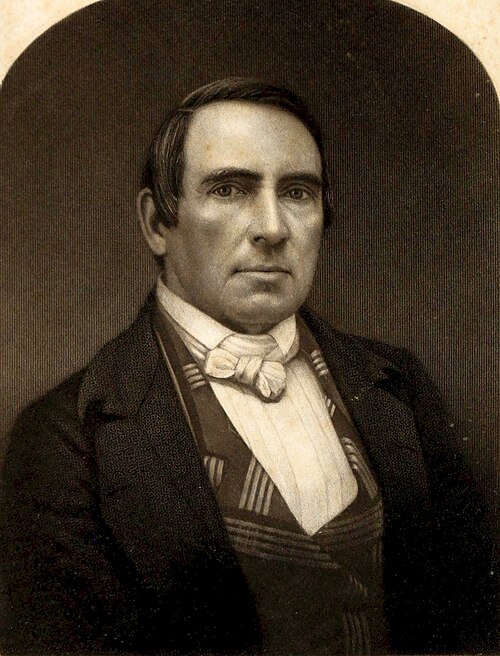
James Blaine
The Public Record
James Gillespie Blaine was an American statesman and Republican politician who represented Maine in the United States House of Representatives from 1863 to 1876, served as Speaker of the House from 1869 to 1875, and was a United States senator from 1876 to 1881. He served twice as Secretary of State, under presidents James A. Garfield and Chester A. Arthur in 1881, and under Benjamin Harrison from 1889 to 1892. He sought the Republican presidential nomination in 1876 and 1880, and received the nomination in 1884, narrowly losing the general election to Democratic nominee Grover Cleveland. Blaine was a prominent figure in the moderate faction of the Republican Party, known as the "Half-Breeds".
gutenberg.org
Fletcher Webster lost his life while bravely commanding a Massachusetts regiment in a war which his illustrious father's exposition of the Constitution had served the arm of the Government to maintain.
Benjamin Harrison of Indiana commanded a brigade before he was thirty, and made a military record which did honor to the illustrious name which he inherits.
The inspiration of a great cause does not fail to ennoble the humblest of those who do battle in its defense.
The same cause brought the same result a century later in men of the same blood fighting with equal valor the same battle of Constitutional liberty.
Their success as civil magistrates, as legislators, as executives was not less marked and meritorious than their illustrious service in war.
They were, moreover, the strong pioneers who settled the first tier of States to the westward, and laid the solid foundation which assured progress and prosperity to their descendants.
The successful mechanics, the thrifty tradesmen, the well-to-do farmers in the old thirteen States were found, in great proportion, to have held a commission or carried a musket in the Army of the Revolution.
After the Continental Army was dissolved, its members were found to be models of industry and intelligence in all the walks of life.
Their experience as soldiers, so far from unfitting them for the duties and callings of Peace, seem rather to have proved an admirable school, and to have given them habits of promptness and punctuality, order and neatness, which added…
The wonder excited by the raising of the vast army which saved the Union from destruction was even surpassed by the wonder excited by its prompt and peaceful dissolution.
From beginning to end the Rebellion was based upon the suppression of that which was true and the suggestion of that which was untrue.
Let us not despond, my countrymen, but, relying on God, meet the foe with fresh defiance, with unconquered and unconquerable hearts." It is clearly established that Mr.
Failure will compel us to drink the cup of humiliation even to the bitter dregs of having the history of our struggle written by New-England historians.
Success records us forever in letters of light upon one of the most glorious pages of history.
Its last words insisted that "failure makes us vassals of an arrogant people--secretly if not openly hated by the most enlightened and elevated portions of mankind.
When the Southern leaders knew the Confederate cause to be hopeless not a single man among them displayed sufficient heroism to brave public opinion with the declaration of his honest belief.
It exhibited Southern men as possessed of the utmost physical courage--often carried indeed to foolish audacity.
Their subsequent course in Congress, in the Cabinet, and in the field, exposed in very striking outline the strong points and the weak points of Southern character.
The Confederates had failed in war, but their leaders had not the moral courage to accept the only practicable peace.
When at last through sheer exhaustion the Confederate Armies ceased resistance and surrendered, they did so on precisely the same terms that had been offered by the Government of the Union three months before.
Every life destroyed in the conflict thereafter was needless slaughter, and the blood of the victims cries out against the Confederate Government for compelling the sacrifice.
However far the laws of war may justify a belligerent in deceiving an enemy, the laws of honorable and humane dealing are violated with one's own partisans when a brave and confiding soldiery are led into a fight known by their commanders…
A grave moral responsibility rests upon those who continue a contest of arms after it is made clear that there is no longer a possibility of success.
The applause so heartily given for the soldiers who were present could not be unaccompanied by tears for the fate of that vast host which had gone down to death without even the consolation of knowing that they had not died in vain.
Politicians like James Blaine