It was the remembrance of this which in all the glad rejoicing over the past and all the bright anticipation of the future lent a tinge of sadness to the splendid and inspiring spectacle of the day.
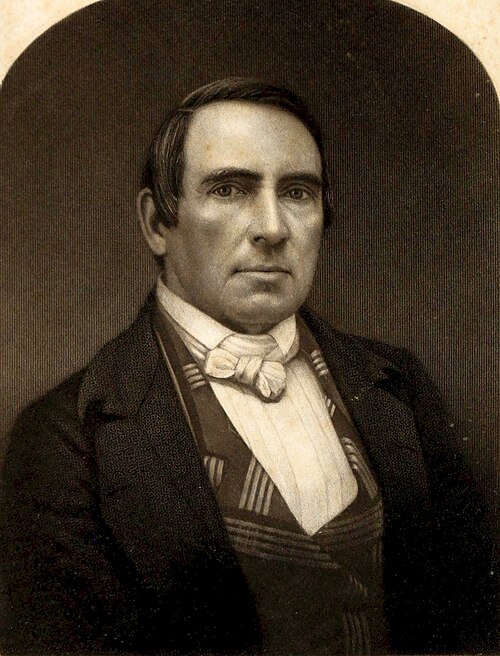
James Blaine
The Public Record
James Gillespie Blaine was an American statesman and Republican politician who represented Maine in the United States House of Representatives from 1863 to 1876, served as Speaker of the House from 1869 to 1875, and was a United States senator from 1876 to 1881. He served twice as Secretary of State, under presidents James A. Garfield and Chester A. Arthur in 1881, and under Benjamin Harrison from 1889 to 1892. He sought the Republican presidential nomination in 1876 and 1880, and received the nomination in 1884, narrowly losing the general election to Democratic nominee Grover Cleveland. Blaine was a prominent figure in the moderate faction of the Republican Party, known as the "Half-Breeds".
gutenberg.org
But the deepest sympathy of the soul is touched, the height of human sublimity is reached, when the same multitude, stricken with a common sorrow, stands with uncovered head, reverent and silent.
A countless multitude of men, with music and banner and cheer and the inspiration of a great cause, presents a spectacle that engages the eye, fills the mind, appeals to the imagination.
They bowed before the bier of him who had ben prophet, priest, and king to his people, who had struck the shackles from the slave, who had taught a higher sense of duty to the true man, who had raised the Nation to a loftier conception of…
For seventeen hundred miles, through eight great States of the Union whose population was not less than fifteen millions, an almost continuous procession of mourners attended the remains of the beloved President.
The pomp with which sovereigns and nobles are interred is often formal rather than emotional, attaching to the rank rather than to the person.
He concluded in words which, deeply impressive at the time, proved sadly prophetic now that his dead body lay in a bloody shroud where his living form then stood: "Sooner than surrender these principles, I would be assassinated on this…
But to those who have deceived, to the conscious, intelligent, influential traitor who attempted to destroy the life of a nation, I would say, on you be inflicted the severest penalties of your crime.
But I say that treason is a crime, the very highest crime known to the law, and there are men who ought to suffer the penalty of their treason! . . .
When the Government of the United States shall ascertain who are the conscious and intelligent traitors the penalty and the forfeit should be paid.
One who has become distinguished in the rebellion says that 'when traitors become numerous enough, treason becomes respectable, and to become a traitor is to constitute a portion of the aristocracy of the country.' God protect the American…
The time has come when the people should be taught to understand the length and breadth, the height and depth, of treason.
Of crime generally our people have a high understanding as well as of the necessity of its punishment; but in the catalogue of crimes there is one, and that the highest known to the laws and the Constitution, of which since the days of…
The time has come, as you who have had to drink this bitter cup are fully aware, when the American people should be made to understand the true nature of crime.
I have become satisfied that mercy without justice is a crime, and that when mercy and clemency are exercised by the Executive it should always be done in view of justice.
I can sympathize with him whose all has been taken from him: I can sympathize with him who has been driven from the place that gave his children birth. . . .
But we must never forget that what may be mercy to the individual is cruelty to the State.
When the question of exercising mercy comes before me it will be considered calmly, judicially-- remembering that I am the Executive of the Nation.
Let it be engraven on every mind that treason is a crime and traitors shall suffer its penalty. . . .
The people must understand that treason is the blackest of crimes and will surely be punished . . . .
We find theft and murder denounced as crimes, and their appropriate penalty prescribed; and there, too, we find the last and highest of crimes,--treason. . . .
The Government must be strong not only to protect but to punish.
The American people must be taught--if they do not already feel--that treason is a crime and must be punished.
No one can say that if the perpetrator of this fiendish deed be arrested, he should not undergo the extremest penalty of the law known for crime; none will say that mercy should interpose.
The record of your past life, familiar to all, your noble efforts to stay the hand of treason and restore our flag to the uttermost bounds of the Republic, give assurance to the great State we represent that we may safely trust the…
Politicians like James Blaine