Upon the direct public issue which he had raised he would undoubtedly have been beaten in nearly all the Northern states, but when his weakness had brought him within fair range of ridicule, he became powerless even in the place of power.
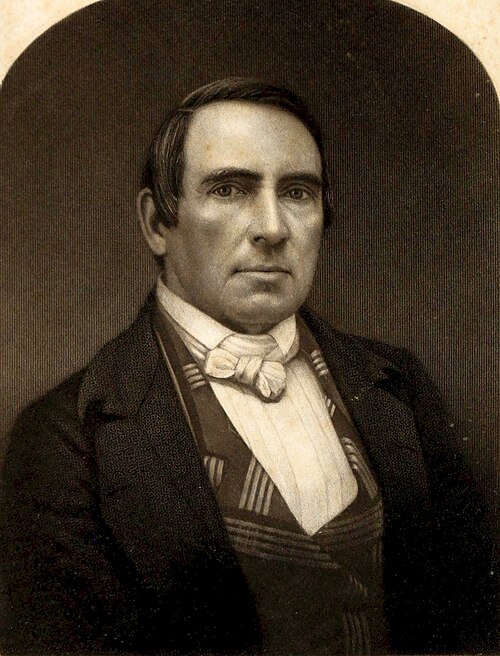
James Blaine
The Public Record
James Gillespie Blaine was an American statesman and Republican politician who represented Maine in the United States House of Representatives from 1863 to 1876, served as Speaker of the House from 1869 to 1875, and was a United States senator from 1876 to 1881. He served twice as Secretary of State, under presidents James A. Garfield and Chester A. Arthur in 1881, and under Benjamin Harrison from 1889 to 1892. He sought the Republican presidential nomination in 1876 and 1880, and received the nomination in 1884, narrowly losing the general election to Democratic nominee Grover Cleveland. Blaine was a prominent figure in the moderate faction of the Republican Party, known as the "Half-Breeds".
gutenberg.org
With whatever strength or prestige the President left Washington, he certainly returned to the Capital personally discredited and politically ruined.
In every way in which public indignation can be expressed, in every form in which public anger can vent itself, the loyal people of the Northern states manifested their feelings, and did not spare in their bitter denunciations the personal…
In their wrathful zeal for justice they would hear no apology and no defense of the President.
The Northern people shrank from the responsibility of transferring the government of States to the control of men who had already shown themselves capable of desperate deeds.
Indeed the people of the United States have rarely been stirred to greater excitement than that aroused by the full details of this nefarious transaction as it came to them through the public press and through official reports.
The men who thought they had the right, as American citizens, to meet for conference refused to be bullied out of their plain privileges under the guarantees of the National Constitution.
Their convention did more to popularize the Fourteenth Amendment as a political issue than any other instrumentality of the year.
It righteously excludes from places of honor and trust the chief conspirators and guiltiest rebels, whose perjured crimes have drenched the land in blood.
It places on a just and equal basis the right of representation, making the vote of a man in one State equally potent with the vote of another man in any State.
That amendment clearly defines American citizenship and guarantees all his rights to every citizen.
And when we say we are ready to stand by the decision of Congress, we only say as soldiers that we follow the same flag and the same principles which we have followed during the war.
We know and all traitors know that the will of the people has been expressed in the complexion and character of the existing Congress. . . .
The citizen soldiery of the United States recognize the Congress of the United States as the representative government of the people.
As soon therefore as it was attempted to secure a political advantage for the Administration by calling the Cleveland Convention, the great mass of Union soldiers demanded that a convention be held in which their true position might be…
In supporting the policy of President Johnson he made a large sacrifice,--large enough certainly to free his action from the slightest suspicion of any other motive than conviction of duty.
These revengeful partisans would leave their country a howling wilderness for the want of more victims to gratify their insatiable cruelty. . . .
If this cannot be accomplished, radical partisans, with a raging thirst for blood and plunder, are again ready to invade the Southern States and lay waste the country not already desolated, with the sword in one hand and the torch in the…
It was evidently the unalterable determination of the Republicans to make that the leading feature of the campaign, to enforce it in every party convention, to urge it through the press, to present it on the stump, to proclaim it through…
The one objective point proclaimed in the address, repeated in the resolutions, echoed and re-echoed by every speaker, both in the Northern and Southern Conventions, was the adoption of the Fourteenth Amendment.
Our last hope, under God, is in the unity and firmness of the States that elected Abraham Lincoln and defeated Jefferson Davis.
The loyal Congress of the United States had refused to do his commands; and whenever you have a Congress that does not resolutely and firmly refuse, as the present Congress has done, to merely act as the recording secretary of the tyrant…
Upon that question, if upon the truth as you feel it, speak the truth as you know it, speak the truth as you love permanent peace, as you may hope to establish the institutions of this Government so that our children and our children's…
These complaints are utterly antagonistic, the one to the other; and this convention is called to say which is right.
It was here in part because the great cry came up from the white man of the South,--My Constitutional and my natural rights are denied me; and then the cry came up from the black man of the South--My Constitutional and my natural rights…
Politicians like James Blaine