The dread alternative between its harsh rule and compliance with the terms of this measure is not suspended, nor are the people afforded any time for free deliberation.
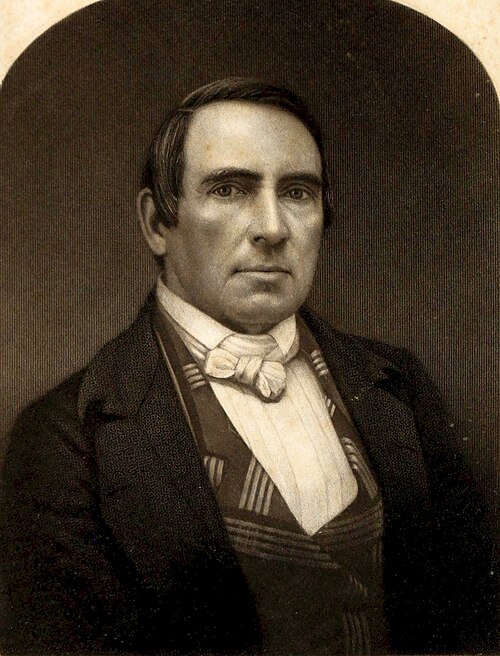
James Blaine
The Public Record
James Gillespie Blaine was an American statesman and Republican politician who represented Maine in the United States House of Representatives from 1863 to 1876, served as Speaker of the House from 1869 to 1875, and was a United States senator from 1876 to 1881. He served twice as Secretary of State, under presidents James A. Garfield and Chester A. Arthur in 1881, and under Benjamin Harrison from 1889 to 1892. He sought the Republican presidential nomination in 1876 and 1880, and received the nomination in 1884, narrowly losing the general election to Democratic nominee Grover Cleveland. Blaine was a prominent figure in the moderate faction of the Republican Party, known as the "Half-Breeds".
gutenberg.org
Rebel generals, wearing the insignia of the rebel service, walk the streets of her cities, admired and courted; while the Union officers with their wounds yet unhealed, are ostracized in political, commercial and social life.
Why, sir, her political power is wielded by rebel hands.
I am not exceedingly favorable to military government anywhere, and if I can get along without it in the Southern States I am anxious to do so.
But suppose the President of the United States approved it, or the next President, if you please, should like the bill, and should veto your measure repealing it, or suppose a bare majority in either House of Congress should like it, then…
Why not, when you send out this military police through the lately rebellious States, send with it that impressive declaration?
I then said that I believed the true interpretation of the election of 1866 was that, in addition to the proposed constitutional amendment, impartial suffrage should be the basis of reconstruction.
Blaine of Maine expressed his unwillingness to support any measure that would place the South under military government, if it did not at the same time prescribe the methods by which the people of a State could by their own action…
It is the vainest delusion, the wildest of hopes, the most dangerous of all aspirations, to contemplate the reconstruction of civil government until the rebel despotisms enthroned in power in these ten States shall be broken up.
We must remove the rubbish, and build from the bottom. . . .
The last one of the sinful ten has at last, with contempt and scorn, flung back in our teeth the magnanimous offer of a generous nation.
Let me remind gentlemen that this has been the history of popular governments everywhere, the reason of their downfall, their decadence, and their death.
I regret exceedingly that those very liberal terms have not been accepted by the South, but I prefer giving those people every opportunity to exhibit a spirit of obedience and loyalty.
For more than two years we have been endeavoring to provide civil governments for that portion of our country, and yet by the provisions of this bill we turn our backs on our policy of the last two years, and by a single stride proceed to…
If it stood by itself, I could not, with my notions of the possibility and practicability of establishing civil governments in the South, based upon loyal suffrage, vote for this bill.
It is because it is entirely the initiative, because it is only the employment of the Army of the United States as a mere police force, to preserve order until we can establish civil government based upon the loyal suffrages of the people…
I could not support a military measure like this if it was to be regarded as at all permanent in its character.
They are engines of oppression against all loyal men.
I declare it as my solemn conviction that no government can long continue to be free when one-third of its people and one-third of the States are controlled by military power.
I do not declare war, but as one American citizen I do prefer war to cowardly submission to a total destruction of the fundamental principles of our Government.
You have already inaugurated enough here to destroy any government that was ever founded. . . .
They fill the hotels, they crowd the avenues, they gather in these marble corridors, they look down from these galleries, and with supplicating eye ask protection from the flag that hangs above the Speaker's chair--a flag which thus far…
Thousands of loyal white men, driven like partridges over the mountains, homeless, houseless, penniless, to-day throng this capital.
Is this what the loyal North has been fighting for?
In all the revolted states, upon the testimony of your ablest generals, there is no safety to the property or lives of loyal men.
Politicians like James Blaine