It was evident that the admission of the States to representation was to be taken as the signal for a new contest in the South--embittered in its character and sanguinary in its results.
James Blaine
The Public Record
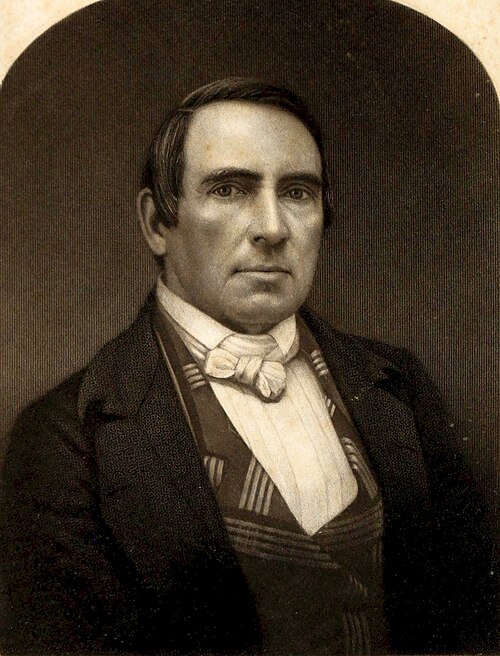
James Gillespie Blaine was an American statesman and Republican politician who represented Maine in the United States House of Representatives from 1863 to 1876, served as Speaker of the House from 1869 to 1875, and was a United States senator from 1876 to 1881. He served twice as Secretary of State, under presidents James A. Garfield and Chester A. Arthur in 1881, and under Benjamin Harrison from 1889 to 1892. He sought the Republican presidential nomination in 1876 and 1880, and received the nomination in 1884, narrowly losing the general election to Democratic nominee Grover Cleveland. Blaine was a prominent figure in the moderate faction of the Republican Party, known as the "Half-Breeds".
gutenberg.org
History and the just judgment of mankind will vindicate the wisdom and the righteousness of the Republican policy, and that vindication will always carry with it the condemnation of Andrew Johnson.
Those conditions--applying to all the States alike, to the loyal and the disloyal in the same measure--must be honorably agreed to by the States that had gone into Disunion before they should be permitted to resume and enjoy the blessings…
As the war to maintain Union and Liberty had cost a vast treasure and sacrificed countless lives, the States that had forced the bloody contest should agree by solemn amendment to the Constitution that the National debt and the pension to…
As the basis of representation in the Constitution has always given the slave States an advantage, these States, now that slavery was abolished, should not be permitted to oppress the negro population and use them merely for an enlarged…
As the vicious theory of State-rights had been constantly at enmity with the true spirit of Nationality, the Organic Law of the Republic should be so amended that no standing-room for the heresy would be left.
As slavery had been the chief inciting cause of disunion, slavery should die.
They held that the States which had rushed into a rebellion so wicked, so causeless, and so destructive, should not be allowed to resume their places of authority in the Union except under such conditions as would guard, so far as human…
The fact that the rebellion fails is the full warrant for its guilty authors to be at once repossessed of all the rights and all the privileges which in the frenzy of anger and disobedience they had thrown away.
If the rebellious State be finally subdued, the National Government must not attach the slightest condition to her re-admission to the Union; must not impose discipline or even administer reproof.
It will require a strong standing army, and probably more than two hundred millions per annum, to maintain the supremacy of negro governments after they are established,--a sum thus thrown away which would, if properly used, form a…
All were ordained in the spirit of liberty, all prohibited the existence of any form of slavery, and all heartily recognized the supreme sovereignty of the National Government as having been indisputably established by the overthrow of the…
But the sympathy which their condition under other circumstances might have evoked in the North, was stifled by the pertinent consideration that they had refused other forms of Reconstruction, and had wilfully drawn upon themselves all…
Under any less authoritative mandate than that which is conveyed in a military order with the requisite force behind it, the Southern communities would never have accepted or submitted to the conditions thus imposed.
I can never give my assent to be made responsible for the faithful execution of laws, and at the same time surrender that trust and the powers which accompany it to any other executive officer, high or low, or to any number of executive…
While I hold the chief executive authority of the United States, while the obligations rests upon me to see that all laws are faithfully executed, I can never willingly surrender that trust or the powers given for its execution.
That is his work and it cannot properly be taken out of his hands.
If ever the American citizen should be left to the free exercise of his own judgment, it is when he is engaged in the work of forming the fundamental law under which he is to live.
No consideration could induce me to give my approval to such an election law for any purpose, and especially for the great purpose of framing the constitution of a State.
He made no long speeches and was not frequently on the floor, but when he rose he spoke forcibly, aptly, attractively, and with that unerring sense of justice which always carried him to the right side of a question, with unmistakable…
He was not a party man in the ordinary sense of the word, but was inclined rather to independence of thought and action.
He exhibited talent in debate, was distinguished for industry in the work of the House and for inflexible integrity in all his duties.
Firm and tenacious in his opinions, even to the point of obstinacy, he was for years an active and useful representative of the people.
He was persuaded that the sectional contest would be fatally pursued as long as the chimerical idea of equality in the Senate should stimulate Southern ambition.
Lincoln's evident motive was to place beyond the calculation, or even the hope of the disloyal States the possibility of ever again having sufficient political power to compete in the Senate for the mastery of the Republic.
Politicians like James Blaine