It gave, as was well said at the time, a far greater influence in National affairs to the vote of the Confederate solider in the South than to the vote of the Union soldier in the North.
James Blaine
The Public Record
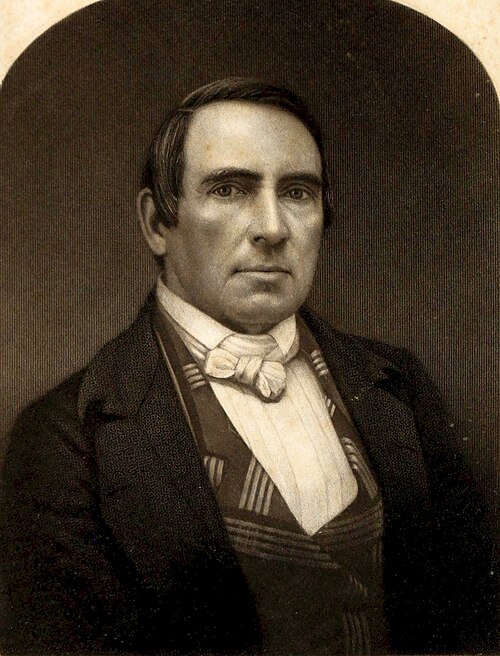
James Gillespie Blaine was an American statesman and Republican politician who represented Maine in the United States House of Representatives from 1863 to 1876, served as Speaker of the House from 1869 to 1875, and was a United States senator from 1876 to 1881. He served twice as Secretary of State, under presidents James A. Garfield and Chester A. Arthur in 1881, and under Benjamin Harrison from 1889 to 1892. He sought the Republican presidential nomination in 1876 and 1880, and received the nomination in 1884, narrowly losing the general election to Democratic nominee Grover Cleveland. Blaine was a prominent figure in the moderate faction of the Republican Party, known as the "Half-Breeds".
gutenberg.org
To concede four and a half millions of negroes to the basis of Southern representation, and at the same time to confine the suffrage to the whites, was not merely a harsh injustice to the colored race, but it was an insulting…
The original provision in the Constitution by which three-fifths of the slaves were enumerated in the basis of representation, agreed to originally as a compromise in connection with the subject of direct taxation, had lost its relevancy…
There is such absolute justice and fair dealing in this proposition, that no reply which deserves to be called an argument has ever been made to it.
On this point the Republicans held, as has been so often repeated, that the negro should not be included in the basis of representation until he was admitted to suffrage.
They deliberately rebelled against a government to which, on their consciences and on their oaths, they had given their personal pledge of fidelity.
But the leaders who, in official position before the war, had solemnly sworn to support the Constitution, were held to be far more guilty than the multitude who followed them.
Such an opportunity would have been a menace to the public credit, and would have proved a constant source of corruption.
It was certainly of inestimable concern to the honor of the country that those who had shed their blood and those who had given their treasure for its defense, should have their claims upon the national justice placed beyond the whim, or…
Even those which may be held as temporary deeply affect more than one generation of American citizens, and are of themselves sufficiently important to justify a great struggle for their adoption.
Every one of the many objects aimed at in the Fourteenth Amendment is founded upon a basis of justice, of liberty, of an enlarged and enlightened nationality.
It seems incredible that Democrats can be satisfied with the record made by their party on this most grave and important question.
It is very seldom in the history of political issues, even when partisan feeling is most deeply developed, that so absolute a division is found as was recorded upon the question of adopting the Fourteenth Amendment.
Lincoln presents a strong contrast with his predecessors,--Pierce and Buchanan,--illustrating afresh the contradiction that the party declaiming most loudly against Executive power has constantly abused it.
Neither Taylor nor Fillmore--both reared in the Whig school --ever attempted to defeat the will of Congress, though each wielded Executive power at a time when questions even more exciting than those of Jackson's era engaged public…
The men who made this outcry defeated John Quincy Adams who never used the veto, and installed Jackson who resorted to it on all occasions when his judgment differed from the conclusion of a majority of Congress.
The Democratic party had its origin and its early growth in the cry against the overshadowing influence of the Presidential office --going so far in their denunciations as to declare that it was aping royalty in its manners and copying…
It will not escape observation that the most frequent resort to the veto has been by those Presidents who were chosen by the political organization which has always declared its hostility to Executive power.
The aggregate number of vetoes, therefore, in the forty years that followed General Jackson's first election exceeded fifty, as against six for the forty years preceding it.
It was followed so vigorously indeed that the forty years succeeding Jackson's advent to power presented a strong contrast with the forty years that preceded it.
An example set by so strong a ruler as Jackson, especially in the establishment of a practice so congenial to man's natural love of power, was certain to be followed by other Presidents.
During his term he thwarted the wish and the expressed resolve of Congress no less than eleven times on measures of great public consequence.
Neither John Adams nor Thomas Jefferson used it even once.
Events, as they developed in the stirring and sorrowful years that followed, were but a continual proof of that form of original blunder on the part of the Southern whites, which in affairs of civil administration is worse than a crime.
The men who had been foremost in plunging their States into the vortex of rebellion were determined to rule them--their determination being of that type which disregards the restraint of law and considers that the end justifies the means.
Politicians like James Blaine