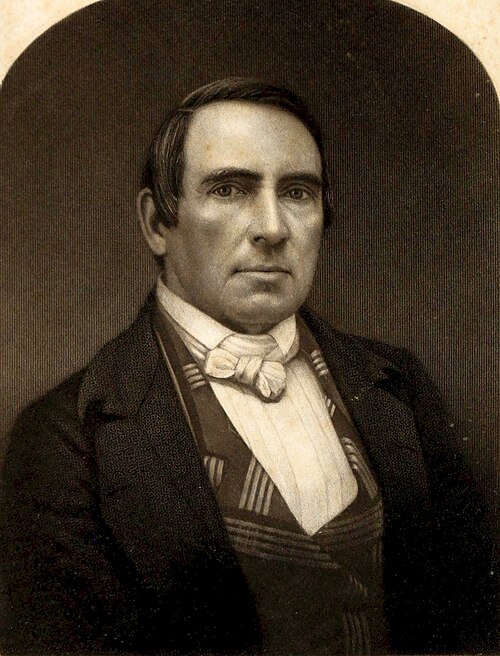
If they can sell a part of our country, they can sell the whole of it!
James Blaine
The Public Record
James Gillespie Blaine was an American statesman and Republican politician who represented Maine in the United States House of Representatives from 1863 to 1876, served as Speaker of the House from 1869 to 1875, and was a United States senator from 1876 to 1881. He served twice as Secretary of State, under presidents James A. Garfield and Chester A. Arthur in 1881, and under Benjamin Harrison from 1889 to 1892. He sought the Republican presidential nomination in 1876 and 1880, and received the nomination in 1884, narrowly losing the general election to Democratic nominee Grover Cleveland. Blaine was a prominent figure in the moderate faction of the Republican Party, known as the "Half-Breeds".
gutenberg.org
If they can buy a part of a country, they can buy the whole of a country.
If they can buy land with money, they can buy money with land.
If the treaty-making power can buy, they can sell.
Whoever of the representatives of the American people in this House, on this question, turns his back, not only upon his duty, but upon the friends of his country, upon the Constitution of his Government, and the honor of his generation…
The pressure of our financial troubles, the fact that gold was still at a high premium, suggested the absolute necessity of economy in every form in which it could be exercised; and in the general judgment of the people the last thing we…
No department of the Government had to contend against so many corrupt combinations to rob the Government, and the slightest relaxation of vigilance on the part of the Commissioner might involve at any time a loss of millions to the…
He developed an admirable talent for details, a quick insight into the most difficult problems that came before the Department, and at all times an honorable devotion to public duty.
But while his politics and his policies were not acceptable to Congress or to the people, he is entitled to high credit for his direct, honest, intelligent administration of the Treasury Department.
These concessions were much needed, for the producers of cotton were crippled by the condition of their States, and manufacturers found that prices did not justify the payment of these war charges.
Great relief was given to manufactures by the abolition of the five per cent tax on a variety of products.
The Secretary argued bravely and wisely in his report, in favor of paying the principal and interest of the Government bonds in coin.
It only depressed production and placed the markets of every kind under the control of reckless operators.
In the end, outside of banking and financial centres, there was a strong and persistent demand for the repeal of the Contraction Act.
Perhaps, in large degree, this was the result of imagination, and of that common desire in human nature to ascribe one's faults and misfortunes to some superior power.
Nor were the cases quite similar in motive and influence, for although it might be admitted that the entire nation would be benefitted by the ultimate result, the people knew that the process would bring embarrassment to vast numbers and…
An individual, by an effort of will, can bring himself to endure present inconvenience and even suffering, for a great good that lies beyond, but it was difficult for forty millions of people to adopt this resolve.
Every Government finds by practice the system of legislation and administration best adapted to its own wants.
But the repugnance to accepting less than par, or allowing the possibility of such a rate, had its origin and support in the patriotic instincts and in the sound judgment of the people.
The natural disinclination of the American people to entrust unrestricted power to any officer was frequently and forcibly expressed.
While the argument in favor of contraction was prosecuted with great force, the possibility of going too fast, even in the right direction, was conceded by the wisest financiers.
The effect of rejecting the measure will be to say to everybody that the Government intends to keep depreciated paper in the financial market.
Defeat this bill, and there will be a jubilee on Wall Street.
The real question is, Shall our Government pay its pensions and all its employees and creditors in depreciated paper, when by borrowing a little money at six per cent it can bring its paper to par?" He charged that an immense lobby against…
As a principle the proposition is dangerous." He protested vigorously against making any part of the public debt payable in foreign countries.
Politicians like James Blaine