Judge Curtis declared that "when the Constitution speaks of treason, bribery, and other high crimes and misdemeanors, it refers to and includes only high criminal offenses against the United states, made so by some law of the United States…
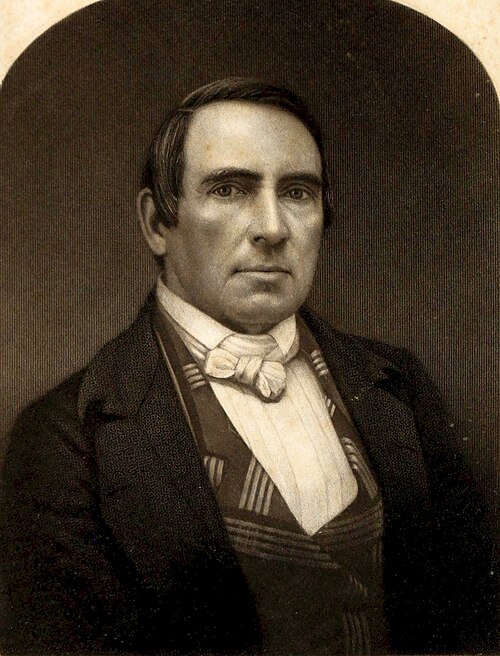
James Blaine
The Public Record
James Gillespie Blaine was an American statesman and Republican politician who represented Maine in the United States House of Representatives from 1863 to 1876, served as Speaker of the House from 1869 to 1875, and was a United States senator from 1876 to 1881. He served twice as Secretary of State, under presidents James A. Garfield and Chester A. Arthur in 1881, and under Benjamin Harrison from 1889 to 1892. He sought the Republican presidential nomination in 1876 and 1880, and received the nomination in 1884, narrowly losing the general election to Democratic nominee Grover Cleveland. Blaine was a prominent figure in the moderate faction of the Republican Party, known as the "Half-Breeds".
gutenberg.org
Thaddeus Stevens, that "in order to sustain impeachment under the Constitution it is not necessary to prove a crime as an indictable offense, or any act malum in se.
It might not be altogether safe to concede to the Executive the broad scope of discretion which General Jackson arrogated to himself in his celebrated veto of the Bank Bill, when he declared that "The Congress, the Executive, and the Court…
If there was a difference of opinion as to the intent and meaning of a law, the general judgment in the case supposed would be that the President had the right to act upon his own conscientious construction of the statute.
In fact there was but one charge of any gravity against the President --that of violating the Tenure-of-office Act.
Besides, the offense charged against the President had been committed nearly two years before, and seemed to be recalled now for popular effect in the construction of the Articles of Impeachment.
Could the President have been legally and constitutionally impeached for these offenses he should not have been allowed to hold his office for an hour beyond the time required for a fair trial.
No impartial reader can examine the record of the pleadings and arguments of the Managers who appeared on behalf of the House, without feeling that the President was impeached for one series of misdemeanors, and tried for another series.
The sober reflection of later years has persuaded many who favored Impeachment that it was not justifiable on the charges made, and that its success would have resulted in greater injury to free institutions than Andrew Johnson in his…
For the Senate to sustain any such plea would in my judgment be a gross violation of the already violated Constitution and laws of a free people.
During all that time this fearful power of Impeachment was in the hands of the legislative department, and more than once a resort to it has been advised by extreme party men, as a sure remedy for party purposes; but happily that evil…
A favorite legislative policy has more than once been defeated by the obstinate and determined resistance of the President, upon some of the gravest and most important questions we have ever had or are ever likely to have.
Can we summon now resources enough of civil prudence and of restraint of passion to carry us through this trial, so that whatever result may follow, in whatever form, the people may feel that the Constitution has received no wound?
We could summon from the people a million of men and inexhaustible treasure to help the Constitution in its time of need.
But we have met by the powers of the Constitution these great dangers--prophesied when they would arise as likely to be our doom--the distractions of civil strife, the exhaustions of powerful war, the intervention of the regularity of…
We never thought that political differences under an elective Presidency would bring in array the departments of the Government against one another to anticipate by ten months the operation of the regular election.
We never thought that the remedy to get rid of a ruler would bring assassination into our political experience.
He had no Act of Congress warranting it, and the Supreme Court has decided that the act was against the express provisions of the Constitution.
Therefore I do not look beyond; but, senators, the people of the United States of America will never permit an usurping Executive to break down the securities for liberty provided in the Constitution.
He believed that the President had committed high crimes and misdemeanors, and he believed that the safety of the Republic required his removal from office.
He exhibited throughout his address the earnestness and the eloquence which come from intense conviction.
His great aim and purpose has been to subvert law, usurp authority, insult and outrage Congress, reconstruct the rebel States in the interest of treason, and insult the memories and resting-places of our heroic dead.
Exclusion of testimony by an arbitrary vote on mere technical objections, especially where men equally learned in the law differ as to its competency and relevancy, is not wise in a political case that depends for its ultimate judgment…
The struggle that followed for the admission or exclusion of testimony obviously strengthened the President's case in popular opinion, which is always influenced by considerations of what is deemed fair play.
He possesses a remarkable combination of wit and humor, and has the happy faculty of using both effectively, without inflicting deadly wounds, without incurring hurtful enmities.
Politicians like James Blaine