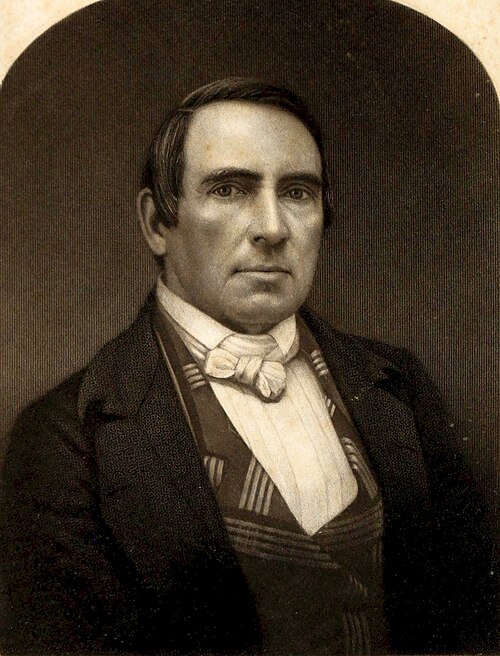
Considering the time of the election, considering the record and the achievements of the rival candidates, the Presidential election of 1868 must be regarded as the most remarkable and the most unaccountable in our political annals.
James Blaine
The Public Record
James Gillespie Blaine was an American statesman and Republican politician who represented Maine in the United States House of Representatives from 1863 to 1876, served as Speaker of the House from 1869 to 1875, and was a United States senator from 1876 to 1881. He served twice as Secretary of State, under presidents James A. Garfield and Chester A. Arthur in 1881, and under Benjamin Harrison from 1889 to 1892. He sought the Republican presidential nomination in 1876 and 1880, and received the nomination in 1884, narrowly losing the general election to Democratic nominee Grover Cleveland. Blaine was a prominent figure in the moderate faction of the Republican Party, known as the "Half-Breeds".
gutenberg.org
General Grant was the embodiment of the war feeling, and presented in his own person the spirit of the contest for the Union and the evidence of its triumph.
The popular judgment had been fixed by events and by a long course of concurrent evidences, and no single plea or pledge could shake it.
He sought also to draw the public thought away from this subject and give it a new direction by dwelling on the cost of government, the oppression of taxes, the losses from the disordered currency and the various evils that had followed…
In his present series of arguments he labored to convince the country that if the Democrats elected the President they would still be practically powerless, and that apprehension of disturbance and upheaval from their success was unfounded.
His speeches were as elusive and illusive as they were smooth and graceful.
With his art of persuasion he combined rare skill in evading difficult questions while preserving an appearance of candor.
No man was more seductive in appeal, or more impressive in sedate and stately eloquence.
The progress of the canvass strengthened this impression; the Democracy was placed everywhere on the defensive; its own declarations shotted every gun that was aimed against it; and its orators and organs could neither make effective reply…
As it was, the rash action of the Democratic Convention made it reasonably clear from the beginning that the ticket was doomed to defeat.
The prestige of Grant's great fame and the momentum given to the Republican party by his achievements during and immediately after the war, would have defeated any opposition, however skillful.
The Democratic party thus determined, through its platform and partially through its candidates, to fight its battle on the two issues of paying the debt in depreciated paper currency and overthrowing Reconstruction.
He insisted, as the supreme issue, that the Reconstruction Acts and their fruits must be overthrown.
Help them once to regain the power, and then they would do their utmost to relieve the Southern States and restore to us the Union and the Constitution as it had existed before the war.
The Democrats had uniformly maintained that the right of suffrage was a question which came within the political power of the States and did not belong to National jurisdiction.
But universal suffrage, especially if ordained by National authority, was irreconcilable with Democratic traditions and Democratic prejudices.
If Chief Justice Chase was to be nominated, the party must accept the broad principle of universal suffrage or it must abandon his lifelong professions.
In his address on the present occasion he arraigned the Republican party for imposing oppressive taxes, for inflicting upon the country a depreciated currency, and for enforcing a military despotism.
They intend Congressional usurpation of all the branches and factions of the Government, to be enforced by the bayonet of a military despotism.
Can there be any doubt as to the designs of the Radicals if they should be able to keep their hold on the reins of government?
Military satraps are invested with dictatorial powers, overriding the decisions of the courts and assuming the functions of the civil authorities; and now this same party which has brought all these evils upon the country comes again…
He drew a dark picture of evils which he charged upon the Republican party, and then proceeded: "Austria did not dare to fasten upon vanquished Hungary, nor Russia to impose upon conquered Poland, the ruthless tyranny now inflicted by…
But it is an old maxim, repeatedly illustrated, that while men are ready to profit by the treason, they instinctively detest the traitor.
He had been a party to the pledge of freedom for the enfranchised race, and the fulfillment of that pledge required, in his judgment, "the assurance of the right of suffrage to those whom the Constitution has made freemen and citizens.
If the Democrats should accept him they must accept this doctrine with him.
Politicians like James Blaine