They did more: they elevated the character and enlightened the conscience of the oppressing race.
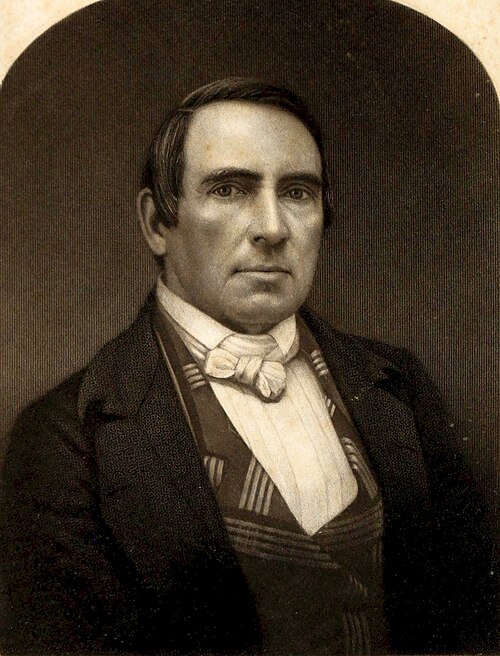
James Blaine
The Public Record
James Gillespie Blaine was an American statesman and Republican politician who represented Maine in the United States House of Representatives from 1863 to 1876, served as Speaker of the House from 1869 to 1875, and was a United States senator from 1876 to 1881. He served twice as Secretary of State, under presidents James A. Garfield and Chester A. Arthur in 1881, and under Benjamin Harrison from 1889 to 1892. He sought the Republican presidential nomination in 1876 and 1880, and received the nomination in 1884, narrowly losing the general election to Democratic nominee Grover Cleveland. Blaine was a prominent figure in the moderate faction of the Republican Party, known as the "Half-Breeds".
gutenberg.org
They gave hope to the hopeless, help to the helpless, liberty to the downtrodden.
But happily there were hundreds of thousands who plainly saw that without the rights of citizenship his freedom could be maintained only in name, and that without the elective franchise his citizenship would have no legitimate and (if the…
There were thousands in their own ranks who did not wish the negro advanced to citizenship; there were tens of thousands who were unwilling to see him advanced to the elective franchise.
Without the Fourteenth and Fifteenth Amendments the Thirteenth would have proved of little value to the oppressed race which it declared to be free.
The Constitutional Amendments were proposed and adopted under the belief that they would be honorably observed and enforced in all the States alike.
Undoubtedly a large proportion of the members of Congress, while following the lead of those who constructed the Fourteenth Amendment, sincerely believed that it possessed a far greater scope than judicial inquiry and decision have left it.
Yet when a vitiated public opinion justifies their course, and when indictment and conviction are impossible, the injured citizen loses his rights as conclusively as if the law had denied them, and indeed far more cruelly.
Those outrages are the deeds of individual citizens or of associated masses, acting without authority of law and in defiance of law.
By decisions of the Supreme Court, the Fourteenth Amendment has been deprived in part of the power which Congress no doubt intended to impart to it.
The defect in both Amendments, in so far as their main object of securing rights to the colored race is involved, lies in the fact that they do not operate directly upon the people, and therefore Congress is not endowed with the pertinent…
The essential and inestimable value of the Fourteenth Amendment still remains in the three other sections, and pre-eminently in the first section.
After the adoption of the Fifteenth Amendment, if a State should exclude the negro from suffrage, the next step would be for the Supreme Court to declare that the act was unconstitutional, and therefore null and void.
When therefore the nation by subsequent change in its Constitution declared that the State shall not exclude the negro from the right of suffrage, it neutralized and surrendered the contingent right before held, to exclude him from the…
Its prime object was to correct the wrongs which might be enacted in the South, and the correction proposed was direct and unmistakable; viz., that the Nation would exclude the negro from the basis of apportionment wherever the State…
Under that section a State could exclude the negro from the right of suffrage, if willing to accept the penalty of the proportional loss of representation in Congress, which the exclusion of the colored population from the basis of…
The gradual progress of public opinion in the United States on questions relating to slavery and to the personal and political rights of the negro race, may be clearly traced in the Thirteenth, Fourteenth, and Fifteenth Amendments to the…
Certain State governments have for the present denied those people the right to vote, and yet one of them is eligible to the Presidency of the United States and another to the Vice-Presidency.
By the Fourteenth Amendment to the Constitution, we have declared that all the black men in Maryland and other States shall be citizens of the United States.
Seymour's vote was fraudulent; and of that fact concealment is no longer attempted from any respectable source.
Indeed, his alleged majority of 47,000 over General Grant was greater than the total vote which the Democratic party could honestly cast in Louisiana.
Within less than five months after her formal reconstruction, outrages which would be exceptional in the governments of Algiers or Egypt were committed in utter defiance of law, and without any attempt at punishment by the authorities of…
One of the most alarming features connected with this series of outrages was the promptness with which Louisiana resorted to violence after her re-admission to the right of representation in Congress.
The change was simply the result of fraud, and the fraud was based on violence.
The result was not comforting to the thoughtful men who interpreted its true significance and comprehended the possibilities to which it pointed.
Politicians like James Blaine