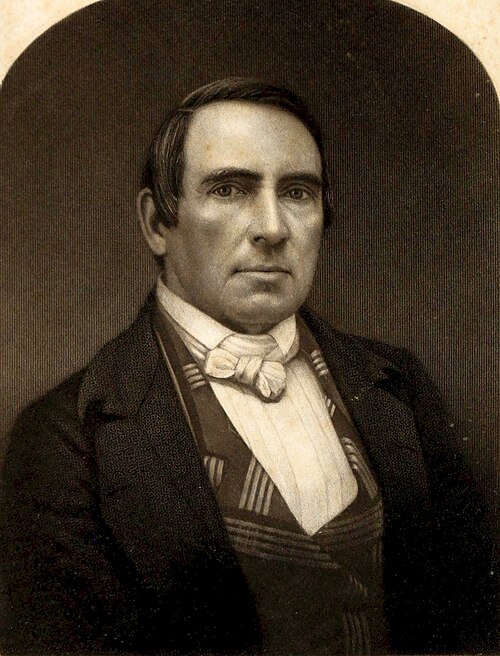
He boasts himself incapable of attachment to party, and in that respect radically differs from the great body of his American fellow-citizens.
James Blaine
The Public Record
James Gillespie Blaine was an American statesman and Republican politician who represented Maine in the United States House of Representatives from 1863 to 1876, served as Speaker of the House from 1869 to 1875, and was a United States senator from 1876 to 1881. He served twice as Secretary of State, under presidents James A. Garfield and Chester A. Arthur in 1881, and under Benjamin Harrison from 1889 to 1892. He sought the Republican presidential nomination in 1876 and 1880, and received the nomination in 1884, narrowly losing the general election to Democratic nominee Grover Cleveland. Blaine was a prominent figure in the moderate faction of the Republican Party, known as the "Half-Breeds".
gutenberg.org
The party he upheld yesterday met with his bitterest denunciations the day before, and to-morrow he will support the political organization of whose measures he is the most merciless censor to-day.
He was affluent in language, graceful in manner, and, beyond all, was gifted with that quality--rare, indefinable, but recognized by every one--which constitutes the orator.
If he had given all his time to the Senate, or all to the Bar, he would have found few peers in either field of intellectual combat.
He perfectly arranged his storehouse of facts and cases, and pondered intently upon the first principles of jurisprudence.
Before that time much reading had made him a very full man: when reading became impossible, reflection digested his knowledge into practical wisdom.
He is independent without self-assertion, courageous without bravado, conscientious without Pharisaism.
Hoar is a Puritan, modified by the religious progress of two centuries, but still a Puritan--in manners, in morals, in deep earnestness, in untiring energy.
Hoar has studied the era with a devout enthusiasm for the character of the people,--a people from whom he is proud to claim his own descent, and whose positive virtues (even with the spice of acridness which distinguished them) are…
He has studied their relations and their interdependence, has analyzed their causes and comprehended their effects.
It may, indeed, be questioned whether his knowledge of our Colonial and Revolutionary history does not surpass that of any contemporary.
But he would not join in secession and turned from a supporter of slavery to be a radical Republican.
He exhibited an exceptional clearness of statement and power of analysis.
In the House of Representatives he rose rapidly in the estimation of his associates and was recognized as a sound and careful legislator, of great industry in the committee-room, and of decided ability as a debater.
Though allied with the Democrats, he was not a bitter partisan, and his course in the House was that of an enlightened and liberal man.
In all respects he was an admirable representative, watchfully caring for the public interests.
He possessed admirable traits for a legislator; being a conscientious worker, intelligent in the business of the House, and implicitly trusted by his fellow-members.
How well he maintained his faith to his country is written in the history of great battles and great victories!
The President had the right under the law to fill the office of Lieutenant-General by selection, and he was not bound even by usage to regard any claim based only upon seniority of commission.
Laws are to govern all alike, --those opposed as well as those who favor them.
In moral as in physical conflicts it may be easy to determine who strikes the first blow, but it is difficult to foresee who may strike the last.
It is yet to be learned with equal emphasis that he who would preserve his own right to suffrage must never aid in depriving another citizen of the same great boon.
Lincoln taught his countrymen the lesson that he who would be no slave must be content to have no slave.
The three great Amendments to the Constitution were bought with a great price--even the blood of the slain--and they will assuredly, in their letter and in their spirit, be vindicated and enforced.
The struggle is not yet ended, the final battle is not yet fought; but complete victory sooner or later is assured.
Politicians like James Blaine